Views: 0 Author: Site Editor Publish Time: 2026-02-26 Origin: Site


In liquid packaging, the stakes are incredibly high. Every decision directly impacts throughput, product integrity, and profitability. Choosing the right equipment involves a crucial shift in mindset: moving beyond the simple "price-per-unit" of a machine to the more strategic "cost-per-filled-container." A poorly matched filler can lead to product giveaway, excessive downtime, and quality control nightmares, eroding margins with every cycle. This technical guide provides a robust framework for your evaluation process. We will help you analyze your product's unique characteristics, understand core filling technologies, and calculate the true total cost of ownership. The goal is to empower you to select a filling machine that aligns perfectly with your specific production realities, not just a vendor's spec sheet.
Viscosity is the primary driver: Your product’s flow characteristics dictate the pump and nozzle technology.
Accuracy equals ROI: A 0.5% increase in precision can save thousands in product giveaway over a single year.
Scalability over speed: Choose modular systems that allow for future integration of capping and labeling.
TCO matters: Factor in changeover times, cleaning (CIP) requirements, and spare parts availability.
The foundation of any successful filling machine selection is a deep understanding of the product itself. Its physical and chemical properties dictate every subsequent decision, from the type of pump to the material of the contact parts. Overlooking these details is a common and costly mistake.
Viscosity, or a fluid's resistance to flow, is the single most important factor. It determines the force required to move the product accurately into a container.
Low-viscosity (water-like) products: Liquids like juices, solvents, and perfumes flow easily. They are well-suited for gravity or overflow fillers that rely on simple principles to manage flow.
High-viscosity pastes: Products like creams, gels, and mascara are thick and resist movement. They require a positive displacement mechanism. For example, an automatic mascara filling machine must use a heavy-duty piston filler to generate enough force to push a precise volume of the thick paste into its small container without air pockets.
Furthermore, temperature can dramatically alter viscosity. "Hot-fill" products like sauces or waxes are filled at elevated temperatures when they are less viscous. The machine must be built to withstand these temperatures, using appropriate seals and insulated components to ensure safety and consistent performance as the product cools.
Does your product contain solids? This question significantly narrows your options. Items like fruit pulps in juice, seeds in dressings, or cosmetic glitters in gels can easily clog standard filling nozzles. You must evaluate the valve and nozzle design carefully. The orifice diameter must be large enough to allow particulates to pass through without being crushed or causing a blockage. Rotary valve piston fillers are often preferred in these scenarios as they provide a clear, unobstructed path for the product.
The product's chemical makeup dictates the materials used for all contact parts—the parts that touch the product. Aggressive or corrosive products can degrade inferior materials, leading to contamination and equipment failure. Key considerations include:
Stainless Steel Grade: While 304 stainless steel is common for food-grade applications, highly acidic or salty products may require 316L stainless steel for superior corrosion resistance.
Seals and Gaskets: O-rings and seals must be compatible. Viton is excellent for many chemicals and high temperatures, while PTFE (Teflon) offers broad chemical resistance. EPDM is often used for water-based products.
Choosing the wrong materials can compromise product safety and lead to costly repairs and unplanned downtime.
Some products change their structure when subjected to stress or pressure. These "shear-sensitive" liquids, such as emulsions, lotions, or certain dairy products, can "thin out" or break down if handled by an aggressive pump. High-speed centrifugal or gear pumps can damage these products. For such applications, low-shear pumps like peristaltic or diaphragm pumps are the ideal choice. They move the product gently, preserving its intended texture and stability.
Once you understand your product, you can select the appropriate filling principle. This choice boils down to a simple question: is it more important for your containers to look equally full, or to contain the exact same amount of product?
Overflow fillers are designed for cosmetic appeal. They fill each container to the same specified height, regardless of minor variations in the container's internal volume. A nozzle seals against the container opening, and liquid is pumped in. Once the liquid reaches the desired level, any excess is drawn back to the supply tank via an overflow port. This method is perfect for transparent containers where customers will see a neat, uniform line of product on the shelf. It is best suited for low-to-medium viscosity, non-foaming liquids.
Volumetric fillers deliver a precise, pre-measured volume of product into each container. This is the technology of choice when dosage accuracy is critical. High-value products like pharmaceuticals, essential oils, or specialty chemicals demand this level of precision to minimize "giveaway"—the costly practice of overfilling to meet label weight requirements. Common volumetric methods include:
Piston Fillers: A piston retracts in a cylinder, drawing in a specific volume of product. It then extends, pushing that exact volume into the container. They are highly accurate (+/- 0.5% is achievable) and versatile enough for liquids, pastes, and creams.
Flow Meter Fillers: A sensor measures the volume of liquid passing through it and signals a valve to close once the target volume is reached. They are flexible and easy to clean.
For applications demanding the absolute highest accuracy, net weight filling is the gold standard. Each container is placed on a load cell (a scale) and tared to zero. The filler then dispenses product until the target weight is reached. This method completely eliminates inaccuracies caused by container volume variations or product density fluctuations due to temperature changes. It is often used for bulk containers (over 5L) or for extremely high-cost industrial chemicals where every gram matters.
Vacuum filling is a specialized form of level filling used for small, rigid containers with narrow openings, like perfume bottles. It is also effective for managing high-foaming liquids. The process creates a vacuum in the container, which then draws the liquid in from the supply tank. This gentle action minimizes turbulence and foam generation. It’s not suitable for viscous products or flexible containers that might collapse under the vacuum.
| Principle | Best For | Key Advantage | Viscosity Range |
|---|---|---|---|
| Overflow (Level) | Transparent containers (beverages, window cleaner) | Consistent visual fill level | Low to Medium |
| Volumetric (Piston) | High-value products (cosmetics, pharmaceuticals) | High dosage accuracy (+/- 0.5%) | Low to Very High (Pastes) |
| Net Weight | Bulk chemicals, expensive ingredients | Highest accuracy, immune to density changes | Wide range, limited by flow rate |
The physical layout and motion control of a filling machine determine its speed, footprint, and cost. The two primary architectures are inline and rotary, each with distinct advantages for different production scales.
Inline fillers arrange filling heads in a straight line over a conveyor. Containers move under the heads, stop for the fill cycle, and then move on. This intermittent motion is simple and effective.
Pros: They generally have a smaller footprint, making them suitable for facilities with limited space. Changeovers between different container sizes are often faster and simpler. The initial investment is typically lower than for a rotary system of similar quality.
Cons: Their start-stop nature limits throughput. Inline systems usually top out at around 200 bottles per minute (BPM), making them ideal for small to medium-sized operations.
Rotary fillers use a large, continuously rotating turret. Containers are fed onto the turret, travel in a circle under the filling heads, are filled, and then exit. The entire process happens in smooth, continuous motion.
Pros: The continuous motion allows for very high speeds, often exceeding 300 BPM and reaching over 1,000 BPM in some applications. They provide superior container handling, reducing the risk of tipping or spilling, especially with unstable containers.
Cons: These machines are significantly larger and represent a much higher capital expenditure. Maintenance is more complex due to the number of moving parts, and changeovers can be more time-consuming.
A key innovation that boosts the efficiency of inline systems is tracking nozzle technology. An automatic tracking nozzles filling machine eliminates the bottleneck of intermittent motion. The filling heads are mounted on a servo-driven system that moves horizontally, synchronizing with the containers as they travel along the conveyor. This "filling-on-the-fly" allows the filling to occur without ever stopping the conveyor belt.
This technology offers another crucial benefit: foam reduction. By programming the nozzles to start filling at the bottom of the container and rise with the liquid level, you can achieve a gentle, "bottom-up" fill. This sub-surface filling method dramatically reduces product aeration, splashing, and foaming, which is critical for products like soaps, detergents, and certain beverages.
Choosing the right level of automation is a balance between capital investment, labor costs, and production goals. As your business grows, your needs will evolve from manual operations to fully integrated, turnkey lines.
For startups or very small-batch production, manual or semi-automatic tabletop fillers are a logical starting point. However, the decision to upgrade is typically driven by ROI. You should consider transitioning when the cost of manual labor, combined with the potential for human error and inconsistent fill rates, exceeds the amortized cost of a semi-automatic or fully automatic machine. Look at your labor costs per filled unit and compare that to the machine's projected output and operating cost.
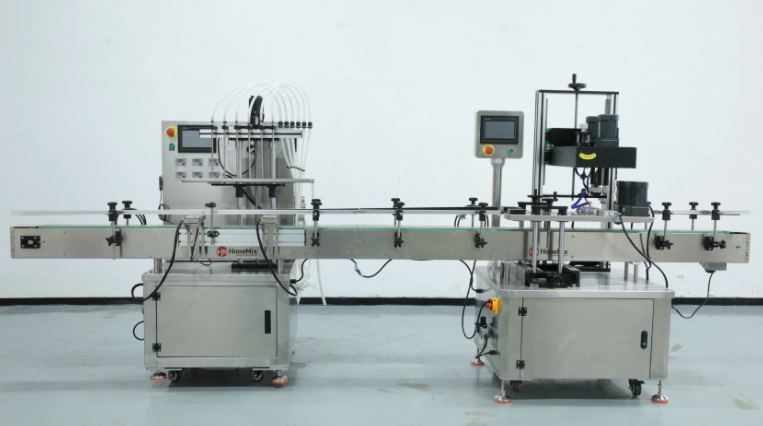
A complete packaging line involves more than just filling. An automatic liquid filling capping machine integrates multiple functions into a single, seamless system. When evaluating these systems, consider the design philosophy:
Monoblock Design: This combines the filler and capper (and sometimes other functions) on a single, unified frame. It offers a compact footprint and perfectly synchronized operation, as all components are controlled by one PLC (Programmable Logic Controller).
Modular Design: This uses separate, standalone machines (filler, capper, labeler) connected by conveyors. This approach offers greater flexibility to upgrade or replace individual components in the future.
The key to success for either design is seamless communication. Ensure that all machines on the line can "talk" to each other, allowing for features like automatic slowdown or stoppage if a downstream machine has a fault. This prevents jams and product waste.
In today's market with its demand for product variety, SKU proliferation is common. This means your line will likely handle multiple container sizes, cap types, and products. The time it takes to switch from one SKU to another is pure downtime. Look for features that minimize this lost time:
Tool-less Adjustments: Guide rails, nozzle heights, and other key points should be adjustable with handwheels or quick-release clamps, not wrenches.
HMI Recipe Saving: A modern Human-Machine Interface (HMI) should allow you to save all the settings for a specific product/container combination as a "recipe." The operator can then simply select the recipe, and the machine will automatically adjust fill volumes, pump speeds, and timing.
The sticker price of a filling machine is only one part of its true cost. A smarter evaluation focuses on the Total Cost of Ownership (TCO) and the Return on Investment (ROI) generated through efficiency and precision.
Filling accuracy has a direct and significant impact on your bottom line. Let's imagine you are filling a 100ml bottle of a product that costs $0.05 per ml.
Machine A (Accuracy +/- 2%): To ensure every bottle has at least 100ml, you must set the target fill to 102ml. This means you are giving away 2ml of product on average per bottle.
Machine B (Accuracy +/- 0.5%): To achieve the same guarantee, you only need to set the target fill to 100.5ml. Your average giveaway is just 0.5ml.
The difference is 1.5ml per bottle. Over a run of 1 million bottles, this translates to 1,500,000 ml (1,500 liters) of lost product. At $0.05/ml, that's $75,000 in savings from the more accurate machine. This often justifies the higher initial investment in a very short period.
Beyond overfilling, consider other sources of product loss. How much product is left in the supply tank, pump, and piping after a production run? A well-designed system will minimize this residual product. Look for features like conical tanks, efficient pump designs, and product recovery cycles that push remaining liquid out of the lines before cleaning.
OEE is a key metric for manufacturing productivity, calculated from Availability, Performance, and Quality. Your filling machine is a critical component of OEE. When evaluating TCO, consider:
Availability: How reliable is the machine? Ask for data on Mean Time Between Failures (MTBF). Crucially, what is the availability of local technical support and spare parts? A machine that is down for a week waiting for a part from overseas is a massive drain on profitability.
Energy Consumption: Factor in the machine's power and compressed air requirements. An inefficient machine will have a higher operating cost over its lifetime.
For industries like pharmaceuticals, food and beverage, and cosmetics, regulatory compliance is non-negotiable. Ensure the machine meets the necessary standards, such as:
GMP (Good Manufacturing Practice): Requires sanitary design with smooth, crevice-free surfaces for easy cleaning.
FDA or CE Standards: Verifies the safety and materials used in construction.
Data Logging: The ability to record and export production data (fill times, weights, fault codes) is often required for batch traceability and validation.
The final stage of selection involves mitigating risks and asking the right questions to ensure the machine you choose will perform as expected in your facility.
Never skip the FAT. This is your opportunity to see the machine run before it leaves the manufacturer's facility. Crucially, you must insist on testing it with your actual products and your exact containers. A machine that runs perfectly with water and standard test bottles may struggle with your foaming liquid or uniquely shaped container. The FAT is your last chance to identify and resolve potential issues before the machine is shipped.
Before signing the purchase order, confirm the machine's final footprint, including necessary clearance for maintenance access and operator movement. Map out the conveyor heights to ensure a smooth transition to your existing upstream and downstream equipment. Verify the required utilities:
Power: What voltage and phase are required? Do you have a dedicated circuit?
Compressed Air: What is the required pressure (PSI/Bar) and flow rate (CFM/LPM)? Is the air clean, dry, and oil-free as specified by the manufacturer?
A machine is only as good as the person running it. A complex HMI with a confusing menu structure can be a major source of errors and downtime. Prioritize systems with intuitive, user-friendly interfaces. Factor the cost of comprehensive operator and maintenance training into your budget. An empowered team that understands the machine will achieve better performance and troubleshoot minor issues without needing to call for service.
As you narrow down your options, ask potential suppliers these critical questions:
Can the machine handle my thinnest and thickest products with minimal change parts?
What is the documented MTBF (Mean Time Between Failures) for this model?
How long does a full CIP (Clean-in-Place) or manual cleaning cycle take, and what resources (water, chemicals) does it consume?
Can you provide references from companies in my industry with similar applications?
What is the standard lead time for critical spare parts?
Choosing the right filling machine is a strategic decision that reverberates through your entire operation. The selection process should follow a clear and logical hierarchy: analyze the product first, then the container, and only then consider the target speed. This product-centric approach ensures you invest in technology that protects your product's integrity and your company's profitability. Be wary of over-specifying; buying a high-speed filler that outpaces your capper or labeler is a wasted investment creating a downstream bottleneck. The ultimate goal is a balanced, efficient, and reliable packaging line. Your final action should be to request a technical consultation, armed with specific data on your product's rheology and your production goals.
A: A piston filler is a type of volumetric filler that uses a cylinder and piston to dispense a highly precise volume of product. It's excellent for a wide range of viscosities, from thin liquids to thick pastes. A pump filler uses a gear, lobe, or peristaltic pump controlled by time or flow meter to measure the volume. Pump fillers are often more flexible and easier to clean, but piston fillers typically offer higher accuracy for viscous products.
A: Yes, some advanced filling machines are designed for this versatility. Piston fillers with interchangeable nozzles and servo-driven controls can often handle a wide viscosity range. The key is to specify your full range of products to the manufacturer. They may recommend different pump or cylinder sets as change parts to optimize performance for both thin and thick products on the same machine chassis.
A: The best method is "bottom-up" or "sub-surface" filling. This involves using long nozzles that descend to the bottom of the container before the fill starts and then retract as the liquid level rises. This technique minimizes turbulence and product aeration. For extremely foamy products, an automatic tracking nozzles filling machine, which fills on the move, can also help by providing a smoother, more controlled process.
A: Regular maintenance includes daily cleaning of all product contact parts, periodic inspection and lubrication of moving components like bearings and chains, and checking seals and gaskets for wear. Most modern machines have a preventative maintenance schedule outlined in the manual. An automatic liquid filling capping machine also requires attention to the capping chucks and clutches to ensure consistent torque application.
A: An automatic tracking nozzle system eliminates the start-stop cycle of traditional inline fillers. Instead of the conveyor halting for each fill, the nozzles move along with the bottles, filling them "on the fly." This continuous motion allows for a significant increase in throughput (BPM) on an inline machine frame, bridging the gap between intermittent-motion and high-speed rotary systems.