Choosing the right drive system for industrial mixing tanks is not simply a motor selection issue. For cosmetic, food, and pharmaceutical manufacturers, the drive system directly affects product consistency, batch repeatability, hygienic compliance, energy consumption, and automation capability. In modern production environments, electric motor-driven systems integrated with PLC controls, VFD speed regulation, and sanitary vessel design have become the preferred solution for most fixed mixing processes. This is especially true for cream, lotion, gel, shampoo, liquid soap, sauce, syrup, ointment, and oral liquid manufacturing.
In this article, you will learn how to evaluate the right mixing tank drive system based on process control, viscosity range, hygienic requirements, and long-term operating cost. We will explain why electric motor-driven mixing tanks dominate most cosmetic, food, and pharma applications, where vacuum emulsifying and homogenizing systems create additional value, and when pneumatic drives are only appropriate for special scenarios such as flammable solvents, ATEX/NFPA hazardous areas, or small mobile drum mixing.
Key Takeaways
Electric motor-driven mixing tanks are the mainstream choice for cosmetic, food, and pharmaceutical production because they offer higher energy efficiency, stable torque output, and better compatibility with PLC and VFD automation systems.
PLC and VFD integration improves batch consistency by delivering repeatable speed control, programmable mixing sequences, alarm monitoring, and easier scale-up for regulated production lines.
Vacuum emulsifying and homogenizing systems are ideal for products such as cream, lotion, gel, ointment, and high-value emulsions that require fine particle size, deaeration, and smooth texture.
Pneumatic drives should mainly be considered for special conditions, including flammable solvent handling, ATEX/NFPA hazardous zones, and lightweight portable drum or IBC mixing applications.
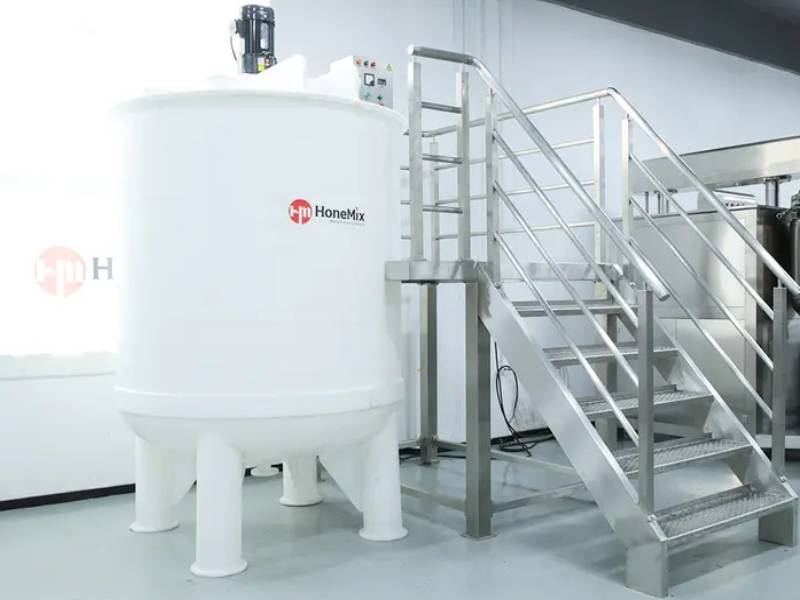
Why Electric Drive Systems Are the Preferred Choice for Modern Mixing Tanks
In most cosmetic, food, and pharma plants, the production target is not merely to rotate an agitator. The real objective is to create a controlled, repeatable, hygienic, and scalable process. That is why electric drive systems are now the preferred option for most fixed stainless steel mixing tanks. They deliver steady mechanical output, integrate easily with digital controls, and support the process stability required for products like lotion, cream, gel, shampoo, syrup, sauce, oral liquid, and liquid soap.
Compared with alternative drive methods, electric systems offer clear operational advantages. They allow precise speed adjustment through VFDs, automatic recipe control through PLCs, and better compatibility with jacket heating, vacuum systems, inline homogenizers, and sanitary instrumentation. For manufacturers investing in higher output and more consistent product quality, these benefits directly support lower batch variation and stronger long-term ROI.
The 5 Most Important Factors When Choosing a Mixing Tank Drive System
1. Process Precision and Batch Repeatability
Precision is essential in cosmetic, food, and pharmaceutical production. A slight deviation in agitator speed, shear rate, or mixing time can affect texture, viscosity, emulsion stability, particle suspension, and final appearance. Electric motor-driven tanks paired with PLC and VFD systems deliver exact RPM control and programmable operation. This makes them ideal for repeatable production of cream, lotion, gel, oral liquid, syrup, shampoo, and liquid soap.
For example, a fixed-speed or manually adjusted mixing setup may be acceptable for simple utility blending. However, when you need multi-step processing such as heating, dispersion, emulsification, vacuum defoaming, cooling, and discharge, digital control becomes critical. Electric systems allow operators to store recipes, manage ramp-up and ramp-down speed profiles, and maintain consistent quality from batch to batch.
2. Compatibility with PLC and VFD Automation
One of the biggest advantages of electric drive systems is automation compatibility. In modern sanitary production lines, the mixing tank is rarely a standalone asset. It must communicate with pumps, heating systems, load cells, level sensors, flow meters, vacuum pumps, and CIP modules. PLC-based control architecture allows all of these process elements to work together in a synchronized way.
VFDs add another layer of control by allowing operators to adjust motor speed precisely according to product viscosity and process phase. A lower speed may be required during feeding and wetting, while higher speed may be necessary during homogenization or final dispersion. This flexibility is especially valuable in stainless steel double jacket homogenizer mixing tank systems where thermal control and shear control must work together.
If your facility plans to scale output, reduce operator dependence, or improve traceability, a PLC and VFD-ready electric drive system should be the baseline specification rather than an optional upgrade.
3. Product Viscosity and Shear Requirements
The correct drive system must match the real rheology of the product. Low-viscosity products such as oral liquid, syrup, or some shampoos may only require moderate agitation and stable circulation. Medium-viscosity products such as liquid soap, food sauces, and cleansing gels often need stronger torque and better flow turnover. High-viscosity emulsions such as cream, lotion, ointment, and cosmetic gel usually demand a more advanced electric mixing solution with homogenizing capability, scraper agitation, or vacuum emulsification support.
Electric motors are well suited for these requirements because they provide stable continuous power and can be configured with gear reducers, high-shear homogenizers, anchor agitators, or multi-shaft arrangements. When paired with a VFD, the same system can handle different process stages more efficiently. This is much more practical for hygienic production than relying on basic airflow-based speed variation.
4. Hygienic Design and Regulatory Compliance
In cosmetic, food, and pharma production, drive selection cannot be separated from hygienic design. The right drive system must support a sanitary tank structure with smooth internal finishes, clean welds, suitable sealing arrangements, CIP compatibility, and contamination control. Electric motor-driven sanitary mixing tanks are easier to integrate into closed hygienic systems because they are commonly designed as part of a complete engineered unit rather than a temporary or portable mixing solution.
This matters for products such as oral liquid, ointment, syrup, cream, and lotion, where residue buildup, cross-contamination, and cleaning difficulty can create major quality risks. Hygienic stainless steel tanks with PLC-controlled mixing and jacketed temperature management provide a more robust process platform for meeting GMP-oriented production expectations.
5. Energy Efficiency and Long-Term Operating Cost
For most fixed production lines, electric drive systems provide a much stronger long-term cost profile than pneumatic alternatives. Electric motors convert a high percentage of input energy directly into mechanical mixing power. They also consume no compressed air and generally stop drawing power when not running. This makes lifecycle cost easier to predict and manage.
In contrast, compressed air systems are usually less energy efficient and depend on stable plant air infrastructure. Air leaks, compressor losses, and line pressure variation all add hidden operating cost. That is why pneumatic drives should not be the default recommendation for mainstream cosmetic, food, or pharmaceutical mixing tanks unless specific hazardous-area conditions apply.
Why PLC and VFD Matter in Cosmetic, Food and Pharma Mixing
PLC and VFD technology do more than automate the motor. They improve the entire manufacturing process. In cosmetic production, operators often need to control heating, vacuum, scraping, emulsification, and cooling in a defined sequence to produce stable cream, lotion, or gel. In food production, recipe accuracy and consistent mixing speed help maintain texture and mouthfeel in sauce and syrup applications. In pharmaceutical production, logged parameters and repeatable mixing conditions support quality documentation and process validation.
A PLC-controlled system can automate valve timing, homogenizer activation, jacket temperature control, vacuum timing, and discharge steps. A VFD allows the motor to run only at the speed needed for each phase, which improves both product protection and energy efficiency. Together, these technologies make electric drive systems far more suitable for advanced sanitary manufacturing than simple manually adjusted alternatives.
When Vacuum Emulsifying Mixing Tanks Are the Better Choice
Standard agitation alone is not always enough. Many cosmetic and pharmaceutical products require much finer dispersion, smoother texture, and lower air entrapment than ordinary mixing can deliver. In these cases, vacuum emulsifying mixing tanks provide a better process solution. They are especially suitable for cream, lotion, ointment, gel, and other high-value emulsions where appearance, stability, and feel directly affect product performance and market acceptance.
A vacuum emulsifying system typically combines electric motor drive, high-shear homogenization, scraper mixing, jacket heating and cooling, and vacuum deaeration. This helps remove bubbles, improve particle refinement, and increase emulsion uniformity. It also supports better filling performance and cleaner final appearance. For premium skincare, personal care, and pharmaceutical semi-solid products, this type of hygienic electric mixing equipment often delivers far more value than a basic open mixing tank.
Application Guide: Which Drive System Fits Which Product?
Product Type | Recommended Drive System | Recommended Tank Configuration |
Cream / Lotion / Ointment | Electric motor + VFD + PLC | Vacuum emulsifying or homogenizer mixing tank with jacket and scraper |
Gel / Shampoo / Liquid Soap | Electric motor + VFD | Sanitary stainless steel mixing tank with optional homogenizer |
Sauce / Syrup | Electric motor + VFD | Jacketed hygienic mixing tank with controlled heating and agitation |
Oral Liquid | Electric motor + PLC + precise VFD control | Closed sanitary mixing tank with high cleanliness standard |
Flammable Solvents / Special Hazardous Liquids | Pneumatic drive | Hazard-area compliant mixer for ATEX/NFPA zone requirements |
Small Portable Drum / IBC Mixing | Pneumatic or lightweight electric, depending on site conditions | Mobile small-batch mixer |
When Pneumatic Drive Still Makes Sense
Although electric systems are the preferred solution for most sanitary production lines, pneumatic drives still have a role in specific conditions. They are most appropriate when the process involves flammable solvents, explosive vapors, or production areas classified under ATEX or NFPA hazardous zone standards. In these environments, spark-free operation is the overriding requirement.
Pneumatic drives may also be suitable for lightweight portable mixers used on drums, IBC totes, or small mobile vessels where compact size and low motor weight are more important than precise automation. However, for mainstream cosmetic, food, and pharmaceutical mixing tanks, they should be viewed as a special-purpose solution rather than the primary recommendation.
A Practical 3-Step Selection Framework
Define your product and viscosity profile: Identify whether you are producing low-viscosity liquids like oral liquid and syrup, medium-viscosity products like shampoo and liquid soap, or high-viscosity emulsions like cream, lotion, gel, and ointment.
Determine your control and hygiene requirements: If your process needs repeatable speed control, heating, vacuum, homogenization, recipe storage, CIP compatibility, or sanitary validation, prioritize an electric motor-driven stainless steel mixing tank with PLC and VFD integration.
Check for exceptional site conditions: Only shift to pneumatic drive if the process involves flammable solvents, hazardous classified areas, or portable small-container mixing where lightweight installation is essential.
Conclusion
For cosmetic, food, and pharmaceutical production, the right mixing tank drive system is usually an electric one. Electric motor-driven sanitary mixing tanks provide the best combination of energy efficiency, stable performance, automation compatibility, and hygienic process control. When integrated with PLC and VFD technology, they create a more repeatable and scalable production platform for products such as cream, lotion, gel, shampoo, liquid soap, sauce, syrup, ointment, and oral liquid.
If your process also requires fine emulsification, vacuum defoaming, or superior texture control, a homogenizer or vacuum emulsifying mixing tank is often the better investment. Pneumatic systems still serve important niche applications, but for most fixed stainless steel mixing equipment in sanitary industries, they should remain a secondary option reserved for hazardous or portable use cases.
Choose electric drive for mainstream sanitary production.
Add PLC and VFD control for precision, automation, and scalability.
Select vacuum emulsifying or homogenizing systems for cream, lotion, gel, and ointment applications.
Use pneumatic drive only for hazardous solvents, ATEX/NFPA zones, or mobile small-batch mixers.
Before requesting a quotation, document your product viscosity, batch size, heating or cooling requirements, vacuum needs, cleaning standard, and automation expectations. This will help you match the right tank configuration to your actual production goals.
FAQ
Q: Why are electric drive systems better for cosmetic, food, and pharma mixing tanks?
A: Electric drive systems offer better energy efficiency, more stable torque output, and easier integration with PLC and VFD controls. This makes them ideal for hygienic, repeatable, and automated production of products such as cream, lotion, gel, shampoo, liquid soap, sauce, syrup, ointment, and oral liquid.
Q: When should I choose a vacuum emulsifying mixing tank instead of a standard mixer?
A: You should choose a vacuum emulsifying mixing tank when your product requires fine emulsification, smooth texture, reduced air bubbles, and higher product stability. This is common in cream, lotion, ointment, cosmetic gel, and similar semi-solid formulations.
Q: What is the role of a VFD in a mixing tank system?
A: A VFD allows precise motor speed control during different processing stages. It helps protect shear-sensitive products, improves consistency, reduces energy waste, and makes the mixing process more flexible for different viscosities and formulations.
Q: Why is PLC control important for sanitary mixing equipment?
A: PLC control makes it possible to automate mixing, heating, cooling, vacuum timing, homogenization, alarms, and discharge steps. This improves batch consistency, reduces operator error, and supports traceable production management in cosmetic, food, and pharmaceutical plants.
Q: Are pneumatic mixers still useful?
A: Yes, but mainly in special situations. Pneumatic mixers are most suitable for flammable solvents, ATEX/NFPA hazardous areas, and small portable drum or IBC mixing applications. For most fixed sanitary mixing tanks, electric systems are the more practical and efficient choice.


