Selecting the right mixing equipment goes far beyond a simple factory upgrade. It represents a critical risk-management decision in skincare cream manufacturing. Batch rejection, active ingredient degradation, and unstable emulsions threaten production lines daily. They cause significant delays and waste highly valuable raw materials. Modern skincare formulations require strict adherence to clean label standards. Consumers consistently demand products free from heavy chemical stabilizers. Therefore, you must invest in precise, physical emulsification technology to guarantee product integrity.
This guide skips basic machine definitions to focus on advanced decision-stage criteria. We explore operational capabilities, mechanical maintenance demands, and implementation realities. You will understand how to evaluate equipment for industrial production effectively. Mastering these details helps you secure consistent product quality across every batch. You will learn how to match equipment dynamics to your unique formulation needs. We also provide actionable strategies to navigate the vendor selection process smoothly.
Key Takeaways
Vacuum is the Standard: A Vacuum Emulsifying Mixer is non-negotiable for high-end skincare, preventing oxidation and eliminating micro-bubbles that compromise texture and stability.
Look Beyond Sticker Price: Up to 30% of mixer failures stem from poor material selection and maintenance design; prioritize 316L stainless steel and integrated Clean-In-Place (CIP) systems.
Facility-First Sourcing: Vendor selection must account for strict facility constraints (e.g., height limitations for lifting mechanisms) and require robust FAT/SAT (Factory/Site Acceptance Testing) protocols.
1. Matching Mixing Dynamics to Complex Formulations
Modern cosmetic formulas present complex engineering challenges for plant operators. Biotechnology active ingredients require meticulous handling during the mixing phase. Peptides, botanical extracts, and heat-sensitive compounds degrade quickly under excessive thermal stress. They also break down if exposed to improper mechanical forces. Encapsulated ingredients like liposomes demand highly specific shear rates. If the shear is too high, the liposome ruptures prematurely. If it is too low, the emulsion ultimately separates. You must navigate this tight operational window with precision equipment.
Standard High-Shear vs. Vacuum Systems
You must choose the right foundational technology for your product line. A standard high-shear mixer works well for basic lotions and simple soaps. It handles resilient ingredients easily. These standard machines rely heavily on mechanical shear and fluid turbulence. However, they naturally trap air inside the mixture during vigorous agitation. This trapped air ruins advanced cosmetic preparations.
Premium formulas demand a entirely different mechanical approach. A Vacuum Emulsifying Mixer removes ambient air completely. Drawing a strong vacuum extracts trapped micro-bubbles from the thick batch. This prevents oxidative degradation of delicate active ingredients. The vacuum environment also directly assists the physical cavitation effect. High-speed rotors create tiny vapor bubbles within the fluid. These tiny bubbles collapse forcefully against the ingredients. This collapse helps break down internal droplets to microscopic sizes. You achieve a tighter, much more stable dispersion without extra chemicals.
Standard SOP Alignment
Your chosen equipment must natively support industry-standard processes. The standard four-step cosmetic Standard Operating Procedure (SOP) dictates specific machine behaviors.
Thermal Pre-mix: The system melts heavy waxes and prepares water phases accurately in side vessels.
High-Shear Homogenization: Rotors and stators force separate liquids together to form the initial emulsion.
Vacuum Deaeration: Negative pressure pulls out remaining air bubbles seamlessly.
Controlled Cooling: Specialized jackets lower the batch temperature evenly to lock in final viscosity.
Machines lacking seamless transitions between these four steps compromise batch integrity.
2. Core Evaluation Criteria for Skincare Cream Manufacturing
You need clear parameters when comparing industrial mixers. Focus strictly on the core components dictating performance and mechanical longevity. A well-specified Cosmetic Emulsifying Mixer prevents daily operational headaches.
Rotor-Stator Configuration
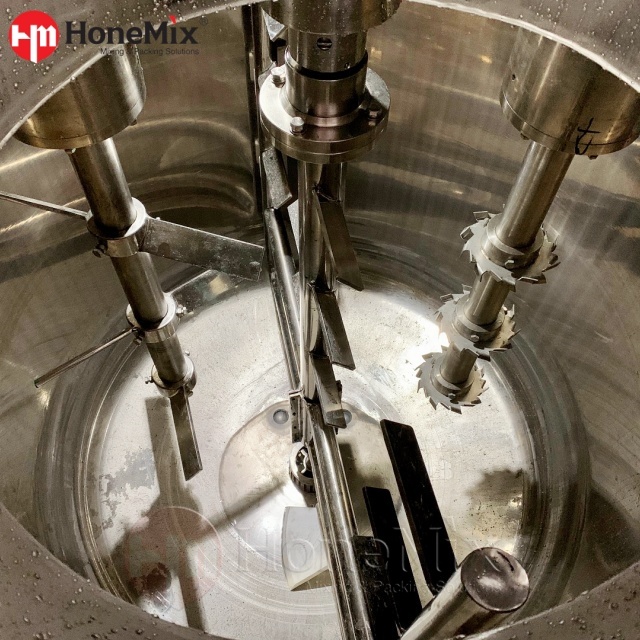
The heart of any emulsifier is its mixing head. You must carefully assess single-pass versus recirculation systems. Target batch viscosity guides this engineering choice. Single-pass configurations work very well for thinner lotions. They push the product through the intense shear zone once. High-viscosity thick creams require external recirculation systems. A recirculation loop pumps thick materials through the homogenizer repeatedly. This ensures uniform droplet size across massive factory batches. It also prevents heavy raw materials from settling out.
Material Compatibility & Durability
Chemical corrosion ruins product batches instantly. It also destroys expensive machinery over time. Your equipment materials must withstand harsh environments.
316L Stainless Steel: This is the absolute baseline for all product contact parts. It resists acidic active ingredients effectively. It also withstands rigorous daily cleaning chemicals.
Specialized Alloys: Certain specialty compounds act highly corrosive. In these cases, you might specify Hastelloy. This premium alloy prevents pitting and long-term metal degradation.
PTFE Scrapers: Wall scrapers must tolerate high heat and constant friction. PTFE (Teflon) provides ideal wear resistance and prevents material burning against tank walls.
Automation & PLC Controls
Repeatability relies entirely on intelligent automation. Variable Frequency Drives (VFDs) give operators precise control over main motor speeds. This flexibility accommodates different complex formula requirements. Programmable Logic Controllers (PLC) take dangerous human error out of the equation. You can program automated temperature ramping and exact hold times. The PLC ensures perfect batch-to-batch consistency. It also logs critical sensory data for quality assurance reviews.
3. Equipment Maintenance and Facility Integration
Ignoring maintenance protocols and facility limits guarantees future production failures. You must evaluate exactly how the machine integrates into your specific physical plant. Even the most advanced technology fails if mechanics cannot service it.
The Maintenance Trap
Industry data reveals a harsh operational reality. A massive percentage of equipment downtime relates directly to maintenance oversights. Complex machines contain numerous moving wear parts. Dual-motion agitation mechanisms reduce overall wear and tear. They balance the mechanical load across multiple axes. Accessible bearing designs also matter immensely. Maintenance teams must reach seals and bearings easily. If a mechanic struggles to access a crucial part, they will likely skip inspecting it altogether.
CIP/SIP Integration
Manual tank cleaning wastes highly valuable production time. Clean-In-Place (CIP) and Sterilize-In-Place (SIP) systems solve this problem immediately. Automated high-pressure spray balls douse the inner tank completely. They remove thick cream residue without requiring manual human scrubbing. Faster changeovers between different cosmetic batches improve overall plant efficiency. It also vastly reduces the risk of dangerous cross-contamination.
Facility Constraints
Plant infrastructure often dictates final equipment design. You must factor in strict installation realities. Standard catalog machines do not always fit existing spaces. Many legacy plants operate under rigid sub-3-meter ceiling limits. Standard hydraulic lifting mechanisms often exceed these heights when fully raised. You must request custom engineering to modify these lifters. Telescopic lifting systems solve low-ceiling layout problems. Fixed-cover designs offer another viable alternative.
Standard Maintenance vs. CIP Integration
Operational Metric | Standard Manual Cleaning | Integrated CIP System |
Changeover Time | 4 to 6 hours | 45 to 90 minutes |
Cross-Contamination Risk | High (human error common) | Very Low (fully automated) |
Labor Requirements | Multiple operators required | Single push-button operation |
Resource Usage | Inconsistent water usage | Optimized and metered |
4. Common Procurement Mistakes to Avoid
Purchasing industrial equipment involves dozens of complex variables. Buyers frequently make critical engineering errors during the specification phase. Avoid these common pitfalls to ensure a smooth, successful commissioning.
Mistake 1: Under-specifying for Scale-Up
Many cosmetics companies buy machines based strictly on current R&D pilot volumes. They fail to project their actual throughput needs for the next three years. This creates a severe laboratory versus industrial capability gap. A small 50-liter lab machine performs very differently than a massive 1000-liter system. Thermal dynamics change drastically at larger physical scales. Heating and cooling massive volumes takes exponentially longer. You must plan for future capacity accurately to avoid bottlenecks.
Mistake 2: Ignoring Utility Requirements
A large mixer requires massive supporting facility infrastructure. Buyers often overlook these secondary plant utility requirements. Industrial chilled water systems must handle the cooling jacket's heavy thermal load. Compressed air systems drive pneumatic valves and heavy lifting mechanisms. You must also carefully calculate the specific power draw (kW) required for peak homogenization speeds. If your plant lacks sufficient electrical capacity, you face major electrical upgrade delays. Industrial steam generators also need careful sizing.
Mistake 3: Overlooking GMP & FDA Compliance Docs
Strict regulatory compliance requires extensive paperwork and documentation. Never assume a vendor provides validation packages automatically. You must secure comprehensive material certificates upfront. Certified weld logs prove the pressure tank's structural integrity. Installation Qualification, Operational Qualification, and Performance Qualification (IQ/OQ/PQ) documents validate the machine's safety parameters. Failing to demand these critical documents delays production launches for several months.
5. Vendor Shortlisting: Assessing Manufacturer Capabilities
Choosing the right manufacturing partner matters just as much as the machine specifications. You need a reliable vendor capable of supporting your long-term operational goals. Scrutinize their supply chain depth and engineering agility.
Supply Chain & Lead Times
Equipment delivery timelines vary wildly across the global industry. Legacy brands often command extremely long lead times. You might wait 12 to 16 weeks for a standard unit from a European manufacturer. Specialized agile manufacturers often deliver in just 6 to 8 weeks. They maintain strict component quality while moving much faster. You must balance brand prestige against your immediate production deadlines.
Customization Flexibility
Standard equipment models rarely fit specialized facility needs perfectly. Score potential vendors heavily on their engineering agility. Can they adapt standard models to your non-standard requests? Some complex formulas require low-level liquid circulation loops. Some sticky mud materials need specific scraper-blade materials. A rigid vendor forces you to change your validated process. A flexible vendor creatively adapts the machine to your formula.
Post-Sale SLA
Equipment lifespans depend heavily on ongoing factory support. Ensure your chosen vendor provides a comprehensive Service Level Agreement (SLA). They must deliver a clear, actionable troubleshooting matrix for common machine errors. You also need ironclad spare parts availability guarantees. A downed machine waiting on overseas parts halts facility production entirely. Insist on detailed routine maintenance schedules to extend the equipment's functional lifespan effectively.
Conclusion
Evaluating and procuring emulsification equipment demands rigorous technical scrutiny. You must balance baseline engineering specifications against long-term operational efficiency. Focus intently on material grades, facility constraints, and advanced automation capabilities. Batch consistency relies entirely on precise temperature and shear controls. Regulatory compliance readiness requires comprehensive vendor documentation from day one. Do not rush this vital procurement cycle.
Your next step involves deep internal facility auditing. Review your current manufacturing footprint closely. Measure ceiling heights, existing electrical capacities, and utility line availability. Compile a highly detailed User Requirement Specification (URS) document. Outline your formula requirements, specific viscosity ranges, and daily throughput targets. Present this comprehensive URS to vendors before requesting any formal equipment quotes.
FAQ
Q: What is the functional difference between a standard high-shear mixer and a Vacuum Emulsifying Mixer?
A: A standard high-shear mixer relies strictly on mechanical turbulence, which often traps ambient air inside the mixture. A vacuum system extracts this air during the emulsification phase. This eliminates micro-bubbles completely. It prevents oxidative degradation of sensitive active ingredients and dramatically improves the final texture and stability of the cosmetic cream.
Q: Can a lab-scale Cosmetic Emulsifying Mixer accurately replicate industrial production results?
A: Direct replication is highly challenging. Scaling up alters shear rates and thermal dynamics significantly. Heating and cooling 1000 liters takes much longer than 10 liters. To bridge this gap, you must select laboratory machines with geometrically similar rotor-stator designs to your intended industrial production units.
Q: What is the average lifespan of a commercial emulsifying mixer?
A: A high-quality industrial mixer typically lasts 15 to 20 years. Lifespan depends heavily on material grade, such as 316L stainless steel, and operational habits. Consistent adherence to CIP cleaning protocols and proactive mechanical seal maintenance are the primary variables determining how long the machine remains viable.


