

Skincare Manufacturing Equipment Solution For Creams, Lotions, Serums And Gels | HONEMIX
Which Equipment Is Best For Different Skincare Formulas
Skincare formulas behave differently during mixing, emulsifying, cooling and filling. A thick cream may require vacuum emulsification and high-shear homogenizing to improve texture and stability, while a light serum may need gentle blending, filtration and accurate small-bottle filling.
HONEMIX provides customized skincare manufacturing equipment solutions for creams, lotions, serums, gels and other cosmetic products. From mixing and emulsifying to filling, capping, tube sealing and complete production line planning, we help manufacturers choose suitable equipment according to formula viscosity, batch size, heating requirements, packaging format and production capacity.
Skincare Manufacturing Equipment At A Glance
For skincare products such as creams, lotions, serums and gels, equipment should be selected according to formula viscosity, batch size, heating requirements and packaging format.
| Product Type | Equipment Direction |
| Creams | Vacuum Emulsifying Mixer + Piston Filling Machine |
| Lotions | Mixing Tank or Vacuum Emulsifying Mixer + Filling Line |
| Serums | Stainless Steel Mixing Tank + Gear Pump Filling & Capping Line |
| Gels | Vacuum Mixing / Emulsifying Mixer + Piston Filling Machine |
What Is Skincare Manufacturing?
Skincare manufacturing is the process of preparing, mixing, emulsifying, homogenizing, cooling, filling and packaging cosmetic products such as creams, lotions, serums and gels. The production process depends on product viscosity, formula structure, ingredient type, batch size, heating requirements and final packaging format.
For example, cream and lotion production usually involves oil phase and water phase preparation, emulsification, vacuum deaeration and controlled cooling. Serum production often focuses on clean blending, filtration and accurate bottle filling. Gel production requires proper thickener dispersion, hydration, bubble control and stable filling performance.
What Products Does This Solution Cover?
This skincare manufacturing solution is suitable for creams, lotions, serums, gels, face creams, body lotions, eye creams, moisturizing creams, sunscreen creams, facial serums, essence products, aloe vera gel, cleansing gel, hand cream, tube-packed skincare products, bottle-packed skincare products and jar-packed skincare products.
HONEMIX can recommend different equipment configurations according to product viscosity, formula process and packaging format.

Skincare Manufacturing Process Overview
A complete skincare production process usually includes raw material preparation, mixing, emulsifying, homogenizing, cooling, storage, filling, capping or sealing, labeling and final packaging.
1. Raw Material Preparation
Oil phase, water phase, powders, active ingredients, fragrances and functional additives are prepared according to the formula. Some materials may require heating, pre-dissolving or controlled feeding before mixing.
2. Mixing And Emulsifying
For creams and lotions, oil and water phases are mixed and emulsified under controlled temperature and shear. Vacuum emulsifying mixers are often used to improve texture, reduce air bubbles and support stable emulsion formation.
3. Homogenizing
High-shear homogenizing helps reduce particle size, improve product uniformity and create a smoother texture. This step is especially important for creams, lotions, gels and other products requiring stable consistency.
4. Cooling And Deaeration
After emulsification or mixing, the product is cooled to the required temperature. Vacuum deaeration helps remove trapped air and reduce foam, improving product appearance and filling stability.
5. Storage And Transfer
Finished bulk material can be transferred to storage tanks or directly to the filling system. Transfer pumps and pipelines should be selected according to viscosity and hygiene requirements.
6. Filling, Capping Or Sealing
Different packaging formats require different filling machines. Bottles, jars and tubes may need piston filling, gear pump filling, capping machines, labeling machines or tube filling and sealing systems.

Cream, Lotion, Serum And Gel Process Comparison
| Product Type | Formula Behavior | Main Process | Recommended Equipment |
| Creams | Medium to high viscosity emulsion | Heating, emulsifying, homogenizing, vacuum deaeration, cooling | Vacuum Emulsifying Mixer + Piston Filling Machine |
| Lotions | Low to medium viscosity emulsion | Mixing, heating, optional homogenizing, filling | Mixing Tank or Vacuum Emulsifying Mixer + Filling Line |
| Serums | Low viscosity liquid | Gentle blending, filtration, small-bottle filling, capping | Stainless Steel Mixing Tank + Gear Pump Filling & Capping Line |
| Gels | Medium to high viscosity thickened formula | Powder dispersion, hydration, vacuum deaeration, filling | Vacuum Mixing / Emulsifying Mixer + Piston Filling Machine |
Skincare Cream Manufacturing Solution
Cream products usually have medium to high viscosity and require stable emulsification, smooth texture and good appearance. During production, common problems include poor emulsification, rough texture, trapped air, batch inconsistency and unstable filling.
For cream manufacturing, HONEMIX usually recommends a vacuum emulsifying mixer with heating, cooling, high-shear homogenizing and vacuum deaeration functions. This type of equipment helps improve cream uniformity, reduce bubbles and support repeatable batch production.
For filling, piston filling machines are commonly used for cream products because they can handle higher viscosity materials and provide stable filling volume for jars, bottles or tubes.
Recommended Machines For Cream Production

How A Spanish Skincare Manufacturer Improved Cream Mixing And Jar Filling Consistency
In a Spain skincare cream production line project, HONEMIX helped the customer build a more controlled process from vacuum cream emulsifying to automatic jar filling and capping.

| Project Location | Spain |
| Application | Skincare And Cosmetic Cream Manufacturing |
| Main Challenge | Cream Texture Stability And Jar Filling Capping Consistency |
| Supplied Equipment | HVE-BLT Vacuum Emulsifying Mixer + AFM-CR Automatic Cream Jar Filling Capping Machine |
This project focused on improving cream texture stability, bubble control, filling accuracy, jar cleanliness, and final packaging consistency.
Lotion Manufacturing Solution
Lotion products are usually lighter than creams but still need stable emulsification and smooth texture. Some lotions require heating and homogenizing, while others may only need mixing, gentle blending and filling.
For lotion production, equipment selection depends on viscosity, emulsification requirements and output target. A stainless steel mixing tank can be used for light lotions or simple liquid products. A vacuum emulsifying mixer is recommended when the lotion requires stronger emulsification, smoother texture or better bubble control.
For bottle packaging, automatic filling and capping lines can improve production efficiency and reduce manual handling.
Recommended Machines For Lotion Production

Serum Manufacturing Solution
Serum products are often low-viscosity liquids packed in small bottles, dropper bottles or pump bottles. Compared with creams and gels, serum production usually focuses more on clean blending, filtration, accuracy and packaging stability.
For serum manufacturing, a stainless steel mixing tank can be used for ingredient blending and preparation. If the product requires a clearer appearance, filtration can be added before filling. Gear pump filling machines are often suitable for low-viscosity serum products because they provide accurate filling and stable operation for small-volume bottles.
Recommended Machines For Serum Production
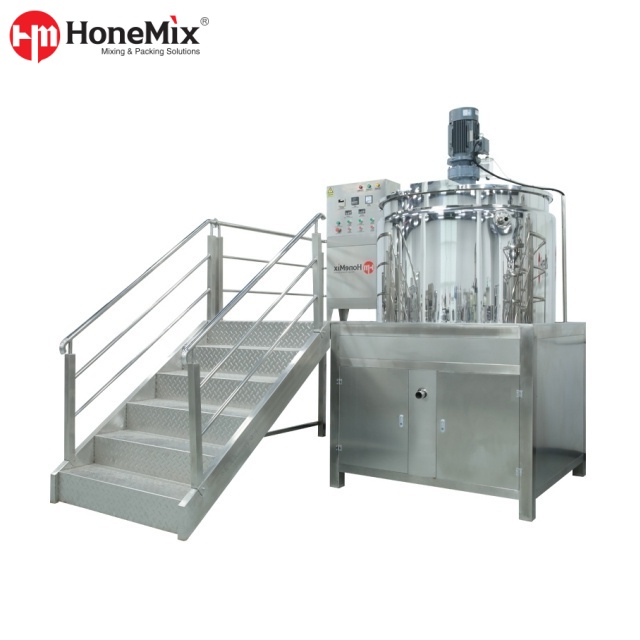
Gel Manufacturing Solution
Gel products often require careful powder dispersion, hydration and bubble control. If thickening agents are not dispersed correctly, the final gel may have lumps, uneven texture or unstable viscosity. If too much air enters during mixing, bubbles may affect appearance and filling performance.
For gel manufacturing, HONEMIX can recommend vacuum mixing or vacuum emulsifying equipment according to viscosity and formula type. Vacuum processing helps reduce air bubbles, while suitable mixing and homogenizing systems help improve gel consistency.
For gel filling, piston filling machines are commonly used because gels usually have higher viscosity than serums or light lotions.
Recommended Machines For Gel Production

Common Skincare Production Problems And Equipment Solutions
| Production Problem | Possible Cause | Recommended Solution |
| Lumps in cream or gel | Powders or thickeners are not fully dispersed | Use proper feeding sequence, high-shear homogenizing and controlled mixing |
| Bubbles in cream or gel | Air enters during mixing or transfer | Use vacuum emulsifying or vacuum deaeration |
| Cream separation | Oil and water phases are not properly emulsified | Use high-shear emulsification and controlled heating/cooling |
| Rough texture | Incomplete homogenizing or unstable process control | Improve homogenizing time, shear level and batch parameters |
| Viscosity changes between batches | Unstable mixing speed, temperature or hydration time | Standardize process parameters and mixing sequence |
| Unstable filling volume | Filling machine does not match viscosity | Use piston filling for viscous products and gear pump filling for low-viscosity liquids |
| Product residue during discharge | Tank structure or outlet design is not suitable | Use sanitary bottom discharge and suitable transfer system |
| Bottle or tube leakage | Capping or sealing system is not matched to packaging | Select suitable capping, sealing or tube filling equipment |
Recommended Equipment For Skincare Manufacturing
As you review the equipment recommended for different skincare products, you may notice that some machines appear more than once. This is because one well-designed machine can often support multiple product types by adjusting the formula, mixing process, homogenizing speed, temperature and production configuration.
For manufacturers, this flexibility is important. It can help reduce repeated equipment investment, improve production efficiency and make future product expansion easier. Below, we will briefly introduce several multi-functional HONEMIX machines that can be used across different skincare manufacturing needs.


Complete Skincare Production Line Configuration
A complete skincare production line can be customized according to formula type, batch volume, packaging format and automation level.
Typical Cream Or Gel Production Line
Water phase tank
Oil phase tank
Vacuum emulsifying mixer
Transfer pump
Storage tank
Piston filling machine
Capping machine
Labeling machine
Cartoning or packaging equipment
Typical Serum Or Lotion Production Line
Stainless steel mixing tank
Filtration system
Storage tank
Gear pump filling machine
Automatic capping machine
Labeling machine
Bottle collection table
Final packaging equipment
Typical Tube Product Production Line
Vacuum emulsifying mixer or mixing tank
Transfer pump
Storage tank
Tube filling and sealing machine
Coding system
Finished tube discharge
Cartoning or packing system
How To Choose Skincare Manufacturing Equipment
Choosing skincare manufacturing equipment should be based on real production requirements, not only product category. Before selecting a machine, buyers should consider the following factors:
1. Product Type
Cream, lotion, serum and gel require different mixing and filling methods. High-viscosity products usually need stronger mixing and piston filling, while low-viscosity liquids may use gear pump filling.
2. Formula Viscosity
Viscosity affects mixer design, homogenizer power, pump type, filling method and discharge structure. It is one of the most important factors in equipment selection.
3. Heating And Cooling Requirements
Some skincare formulas require oil and water phase heating, temperature holding and controlled cooling. Jacketed tanks or emulsifying systems may be required.
4. Emulsification Requirements
If the formula contains oil and water phases, emulsification stability is important. Vacuum emulsifying mixers are usually recommended for creams and lotions that require stable texture.
5. Bubble Control
For creams and gels, air bubbles can affect appearance, filling and final product quality. Vacuum mixing and deaeration can help reduce trapped air.
6. Batch Size
Small batch production may use laboratory or pilot-scale equipment. Larger production may require 50L, 100L, 300L, 500L, 1000L or higher capacity systems.
7. Packaging Format
Bottles, jars and tubes require different filling and sealing systems. Filling accuracy, capping type, tube material and container shape should be confirmed before equipment selection.
8. Automation Level
Start-up brands may choose semi-automatic equipment, while OEM/ODM factories and growing manufacturers may need automatic filling, capping, labeling and packaging lines.
Buyer Information Checklist
To recommend a suitable skincare manufacturing solution, HONEMIX usually needs the following information:
Product type: cream, lotion, serum, gel or other skincare product
Formula viscosity: low, medium or high viscosity
Batch capacity: such as 50L, 100L, 300L, 500L, 1000L or customized
Heating requirement: yes or no
Vacuum requirement: yes or no
Homogenizing requirement: yes or no
Filling volume: such as 5ml, 30ml, 50ml, 100ml, 250ml or customized
Packaging type: bottle, jar, tube or other container
Cap or sealing method: screw cap, pump cap, dropper, tube sealing or other type
Target output: bottles per hour or tubes per minute
Factory layout requirement: available space and production flow
Automation level: semi-automatic, automatic or complete line
Real Skincare Production Experience
In real skincare manufacturing projects, buyers usually do not only need one machine. They often need to match the mixer, transfer pump, storage tank, filling machine, capping machine, labeling machine and factory layout according to formula viscosity and packaging format.
HONEMIX supports customers from early equipment selection to production line planning. Our team can help evaluate product type, batch size, viscosity, filling volume, bottle or tube type and automation requirements before recommending equipment.
For OEM/ODM cosmetic factories, a well-planned skincare production line can help improve production efficiency, reduce manual operation, improve product consistency and support future capacity expansion.
Why Choose HONEMIX For Skincare Manufacturing Equipment?
HONEMIX is a cosmetic, food and pharmaceutical machinery manufacturer providing customized mixing, emulsifying, filling and complete production line solutions.
With nearly 20 years of industry experience, HONEMIX helps global manufacturers select suitable equipment for skincare, personal care, home care, food and pharmaceutical production. Our solutions are designed around real production needs, including product viscosity, formula characteristics, packaging format, output target and factory layout.
Customized Equipment Solutions
Every skincare formula is different. HONEMIX can recommend machine configuration according to product type, viscosity, batch size and packaging format.
Complete Production Line Support
We can provide single machines or complete production line solutions, including mixers, emulsifying systems, filling machines, capping machines, labeling machines and packaging equipment.
Practical Engineering Experience
HONEMIX focuses on practical production problems such as emulsification stability, bubble control, filling accuracy, cleaning convenience and line integration.
Factory Testing And Service Support
Before delivery, equipment can be tested and checked according to customer requirements. HONEMIX also provides technical communication, online support and after-sales service for global customers.
Skincare Manufacturing Equipment FAQ
1. What equipment is needed to manufacture skincare products?
Skincare manufacturing usually requires mixing tanks, vacuum emulsifying mixers, homogenizers, transfer pumps, storage tanks, filling machines, capping machines, labeling machines and packaging equipment. The final equipment configuration depends on product type, viscosity, batch size and packaging format.
2. What machine is used to make cosmetic cream?
A vacuum emulsifying mixer is commonly used to make cosmetic cream. It can support oil-water emulsification, high-shear homogenizing, vacuum deaeration, heating, cooling and controlled mixing, helping create smooth and stable cream texture.
3. What is the difference between cream and lotion manufacturing?
Creams usually have higher viscosity and often require stronger emulsification, vacuum processing and piston filling. Lotions are usually lighter and may use mixing tanks or emulsifying mixers depending on formula stability, texture and production requirements.
4. What equipment is suitable for serum production?
Serum production usually uses stainless steel mixing tanks, filtration systems, storage tanks and gear pump filling machines. For small bottles, automatic filling and capping systems can improve filling accuracy and production efficiency.
5. How do you remove bubbles from skincare gels?
Bubbles in skincare gels can be reduced by using vacuum mixing or vacuum deaeration. Proper powder dispersion, controlled mixing speed and suitable transfer methods can also help reduce air entering the product during production.
6. Can one machine make cream, lotion and gel?
One vacuum emulsifying mixer can often be used for creams, lotions and gels, but the process parameters may be different. Mixing speed, homogenizing time, heating temperature, vacuum level and discharge method should be adjusted according to each formula.
7. What filling machine is best for cosmetic cream?
A piston filling machine is usually suitable for cosmetic cream because it can handle medium- to high-viscosity products and provide stable filling volume. The machine can be configured for bottles, jars or other containers according to packaging needs.
8. What filling machine is suitable for serum bottles?
A gear pump filling machine is often suitable for serum bottles because serum is usually a low-viscosity liquid. It can provide accurate filling for small-volume bottles and can be combined with automatic capping and labeling systems.
9. How do I choose between piston filling and gear pump filling?
Piston filling is usually better for creams, gels and high-viscosity products. Gear pump filling is commonly used for low-viscosity liquids such as serums, toners and light lotions. The final choice depends on viscosity, filling volume and accuracy requirements.
10. What is a complete skincare production line?
A complete skincare production line usually includes raw material preparation, mixing or emulsifying, homogenizing, cooling, storage, transfer, filling, capping or sealing, labeling and final packaging. The line can be customized according to product and production scale.
11. What batch size should I choose for a skincare mixer?
Batch size should be selected according to daily output, product type, formula process and factory plan. Common options include laboratory scale, 50L, 100L, 300L, 500L, 1000L and larger customized systems.
12. Can HONEMIX customize equipment for my formula and packaging?
Yes. HONEMIX can recommend and customize skincare manufacturing equipment according to formula viscosity, batch size, heating and cooling needs, filling volume, bottle type, tube type, cap style and automation level.
Need To Evaluate Your Skincare Production Process?
Every skincare formula behaves differently during mixing, emulsifying and filling. Before selecting equipment, it is better to evaluate the product viscosity, formula structure, batch size, packaging format and target output.
HONEMIX can help review your production requirements and identify suitable equipment for cream, lotion, serum or gel manufacturing.