Transitioning from lab-scale formulation to commercial manufacturing marks a critical milestone for growing cosmetic brands. You finally have a winning skincare formula. Scaling it up, however, frequently exposes hidden vulnerabilities in your production process. Emulsion failure, phase separation, and micro-bubble oxidation easily ruin entire batches. These common issues waste expensive raw materials. They ultimately compromise your brand reputation and erode customer trust in your products.
We designed this guide to solve these exact scaling hurdles. It provides an evidence-based, objective evaluation framework for selecting commercial mixing equipment. We will help you ensure strict batch-to-batch consistency. You will learn how to achieve high returns on investment quickly. Crucially, you will discover how to scale your factory operations efficiently without over-capitalizing on unnecessary automation right out of the gate.
Key Takeaways
A Vacuum Emulsifying Mixer is the commercial standard to prevent active ingredient degradation and microbial growth caused by aeration.
Successful equipment selection relies on matching rotor-stator shear capabilities (often ~3000 RPM) with precise temperature controls (heating to 80°C, cooling below 40°C).
For emerging brands and small-to-medium factories, semi-automatic 15L to 200L configurations offer the best balance of flexibility, cost, and scalability.
Face creams and body creams require different mechanical handling; your machine must support variable speed controls (e.g., limiting shear to ~120 RPM for delicate, ceramide-heavy formulations).
Why the Vacuum Emulsifying Mixer is the Industry Standard
Manufacturers face significant challenges when moving away from simple benchtop mixing. We must address the physical realities of combining oil and water phases at a commercial scale.
The Problem with Open-Air Mixing
Traditional overhead mixers and open vessels create massive stability problems. They constantly trap micro-bubbles inside the emulsion during rapid agitation. This unintended aeration drives rapid oxidation of fragile antioxidants like Vitamin C. Air pockets also create a dangerous breeding ground for aerobic bacteria.
Oxidation risks: Active ingredients lose efficacy rapidly when exposed to trapped oxygen.
Visual defects: Micro-bubbles cloud transparent gels and give lotions a frothy, unprofessional appearance.
Accelerated aging failures: Accelerated aging tests on open-air batches routinely show rapid color shifts and drastic viscosity drops within weeks.
The Vacuum Advantage
Drawing a negative pressure inside the mixing chamber changes the physics of emulsification. It stabilizes your formula instantly. The vacuum environment aggressively pulls trapped air out of the viscous liquid. This yields a remarkably smoother, glossy texture. Furthermore, it protects heat-sensitive and oxygen-sensitive active ingredients from premature degradation. You extend your product shelf life significantly just by removing oxygen from the production environment.
Mechanics of High Shear
Simple stirring paddles cannot create long-lasting emulsions. You absolutely need a robust rotor-stator homogenizer. This precision-engineered component forces the oil and water phases through a microscopic mechanical clearance. Standard operations require sustained speeds around 3000 RPM. This intense mechanical energy shears the liquids into microscopic droplets. These uniform micro-droplets permanently prevent oil-water separation over your product's intended shelf life.
| | Chart: Open-Air vs. Vacuum Mixing Performance |
Performance Metric | Open-Air Mixing | Vacuum Homogenization |
Oxidation Rate | High (Rapid active degradation) | Extremely Low (Oxygen removed) |
Droplet Size Distribution | Inconsistent (5 - 20 microns) | Highly Uniform (1 - 3 microns) |
Microbial Risk Factor | Elevated (Air pockets harbor bacteria) | Minimal (Anaerobic processing environment) |
Texture Quality | Prone to froth and air holes | Glossy, dense, and perfectly smooth |
Core Technical Specifications to Evaluate for Cream Production
Purchasing an industrial mixer requires evaluating specific engineering components. Every feature must align with your strict formula requirements.
Heating and Cooling Jackets
Perfect emulsions demand strict thermal management. Formulators must melt thick oil and wax phases at 70°C to 80°C. Afterward, the entire batch requires rapid, controlled cooling below 40°C. You must hit this lower temperature threshold to safely introduce volatile fragrances and heat-sensitive preservatives. You should carefully evaluate your heating options.
Electric heating jackets suit smaller operations perfectly. They plug into existing industrial power grids easily. Conversely, steam-heated jackets provide much faster, highly efficient thermal transfer for massive vessels. However, steam requires external boilers and complex facility plumbing.
Material Compliance and Hygiene
Cosmetic Good Manufacturing Practices (cGMP) dictate stringent material standards. You must require 316L stainless steel for all product-contact parts. This specific alloy contains molybdenum. It resists corrosive cosmetic chemicals, high-salinity solutions, and harsh cleaning agents perfectly. You can safely use standard 304 stainless steel for the machine's non-contact exterior. This strategic material combination ensures long-term durability while simplifying mandatory sanitation procedures.
Agitation Systems
Superior agitation requires advanced mechanical control. Look closely for dual-speed options or variable-frequency drives (VFD). Your equipment must pair the high-shear bottom homogenizer seamlessly alongside a robust wall-scraping paddle agitator. Teflon scrapers sweep the inner heated vessel walls constantly. This scraping action prevents the localized burning of thick waxes. It guarantees perfectly uniform heat distribution across your entire batch.
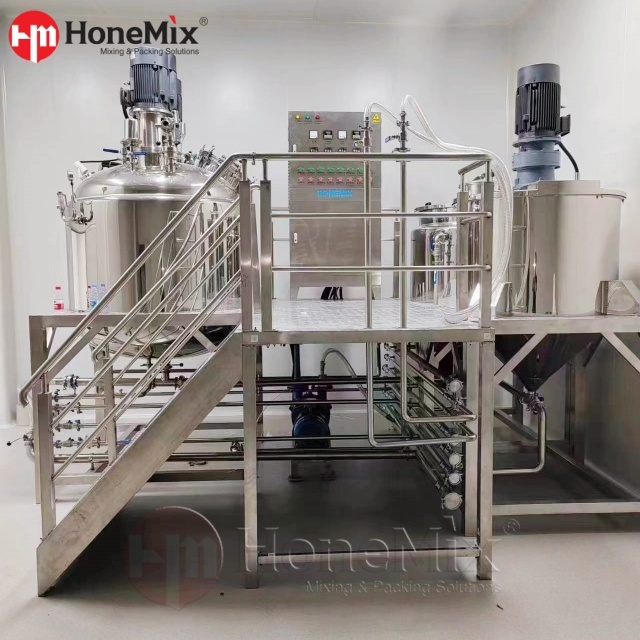
Adapting Equipment for Face Cream and Body Cream Production
Scaling up face cream and body cream production requires specialized mechanical handling. Different textures react differently to heat and physical stress.
Viscosity Differences
Thick body butters demand massive motor torque. Moving dense, clay-like masses challenges standard mixer motors quickly. You need specialized paddle designs to handle these heavy loads. Angled Teflon wall scrapers push thick creams back toward the central homogenizer constantly. This continuous folding action prevents motor burnout. It ensures homogeneous mixing even when producing extra-heavy winter moisturizers.
Formulation Sensitivity
Lightweight facial moisturizers behave quite differently. Products designed for sensitive skin often feature delicate lipid bilayers. Consider specialized rosacea or eczema treatments. Extreme high shear forces easily destroy these fragile molecular structures. Your machine must allow operators to bypass high-speed homogenization entirely. You need to utilize low-speed, extended mixing modes instead. Limiting speeds to a maximum of 120 RPM prevents friction-induced heat. It stops unexpected emulsion breaking completely.
Versatility
A properly spec'd Cream Making Machine offers immense production flexibility. It switches seamlessly between high-shear homogenization for stable lotions and gentle blending for complex facial treatments. This operational versatility maximizes your capital investment. You can run heavy body butters on Monday and ultra-light serums on Tuesday using the exact same hardware.
Sizing Your Equipment: Capacity, Automation, and ROI
Buying the wrong size vessel damages your operational efficiency. We must evaluate usable capacity and long-term financial returns accurately.
Volume vs. Usable Capacity
A 50L tank never yields 50L of usable product. Vacuum expansion requires adequate headspace to function safely. High-speed agitation also causes significant fluid displacement. Equipment manufacturers generally recommend filling vessels only to 70% or 80% of their total internal volume. Always factor this functional limit into your daily yield calculations. A 100L tank typically processes about 75L to 80L of active product safely.
The Semi-Automatic Sweet Spot
Let us compare manual, semi-automatic, and fully automatic configurations to find the best fit for emerging brands.
Manual blending: Wastes excessive labor, creates severe inconsistencies, and severely limits daily output.
Fully automated systems: Demand massive upfront capital, require specialized engineers, and lack the flexibility for small custom runs.
Semi-automatic systems: Hit the perfect sweet spot for daily outputs ranging from 50kg to 200kg.
Semi-automatic configurations minimize your initial capital expenditures. Simultaneously, they significantly reduce labor costs and cut batch turnaround times drastically compared to manual methods. They strike the ultimate balance of cost and performance.
ROI Calculation Logic
You must justify your equipment purchase through measurable financial improvements. Focus your financial logic on the tangible reduction of cost-per-liter.
Waste Reduction: Better equipment minimizes raw material waste instantly. Scraping agitators recover more product from the tank walls.
Speed Improvement: Faster heating, emulsifying, and cooling cycles increase your daily output capacity. You can produce three batches daily instead of just one.
Failure Elimination: Vacuum homogenization prevents failed or separated batches. You save money every time you avoid discarding expensive active ingredients.
Common Procurement Risks and Implementation Blind Spots
Many brands make critical errors during the procurement phase. You can avoid these expensive pitfalls by carefully assessing your facility and operational needs.
Oversizing Too Early
Buying a massive industrial unit for small-batch operations creates severe minimum-fill issues. The bottom homogenizer requires complete liquid submersion. If the liquid level fails to cover the rotor, the homogenizer simply cannot function. It will aggressively whip air into the product instead of emulsifying the oils. Buy equipment scaled for your actual current sales, not a hypothetical five-year projection.
Overlooking Clean-In-Place (CIP) Capabilities
Sanitation bottlenecks destroy daily operational efficiency. Inadequate drainage designs trap residual creams at the bottom of the tank. Hard-to-reach valves increase your downtime between product batches. Complex machinery requiring complete, manual teardowns ruins your production schedule. Prioritize equipment featuring integrated CIP spray balls. Ensure the vessel utilizes sloped discharge valves for complete gravity-assisted drainage.
Ignoring Facility Constraints
Evaluate your physical infrastructure thoroughly before finalizing any purchase agreement.
| | Facility Checklist for Equipment Installation |
Constraint Category | What to Assess | Potential Risks |
Power Supply | 3-phase vs. single-phase voltage availability | Motor incompatibility; expensive electrical rewiring |
Floor Load | Weight-bearing limits of the production floor | Structural damage from fully loaded water-jacketed tanks |
Clearances | Doorway widths and ceiling heights | Inability to physically move the machine into the cleanroom |
Conclusion
Selecting the right production equipment secures your brand's future quality and profitability. You should define your hardest-to-mix formula first. Use its viscosity and thermal limits as your baseline equipment requirements. Next, determine your optimal batch size based strictly on current sales plus a modest 20% growth margin. You must mandate vacuum integration and high-shear capabilities for any serious commercial endeavor.
Finally, never purchase industrial machinery blindly. We strongly recommend scheduling a pre-purchase Factory Acceptance Test (FAT). Alternatively, request formal vendor lab-testing using your actual raw materials. Prove the machine's capability to handle your specific emulsion before deploying your capital.
FAQ
Q: Does vacuum technology actually improve the shelf-life of face creams?
A: Yes. By removing air during the emulsification phase, vacuum mixing prevents the oxidation of delicate active ingredients. It removes air pockets where aerobic bacteria can thrive. This technology leads to demonstrably better stability in accelerated aging tests, preserving color and viscosity.
Q: Can one machine handle both lightweight lotions and heavy body creams?
A: Yes, provided the equipment features variable speed controls. You need a robust scraping agitator to move thick viscosities effectively. Additionally, your high-shear homogenizer must be independently controlled. This allows you to adjust the mechanical force based on each formula's unique requirements.
Q: What is the minimum batch size I can run in a commercial Cream Making Machine?
A: Most vacuum emulsifying mixers require the vessel to be filled to at least 25% to 30% of its total capacity. This minimum volume ensures the bottom homogenizer remains fully submerged. Always verify the minimum working volume with the manufacturer to avoid aerating the product.


