Batch rejection in chemical, cosmetic, and food processing often stems from phase separation, agglomeration, and trapped air. These hidden failures cost facilities significantly in wasted raw materials and lost production time. Standard agitation simply falls short for highly complex formulations. Relying on basic mixing cannot achieve the uniform particle size reduction you need without introducing detrimental aeration. To fix this, you need a highly specialized mechanical approach. Precision high-shear processing forces immiscible liquids and stubborn powders into a perfectly homogeneous state. Transitioning from standard mixers to advanced processing equipment fundamentally changes your daily production reliability. Specifically, operating in a vacuum environment actively protects your mixture from oxygen degradation. This approach secures long-term product viability and permanently eliminates the micro-bubbles that ruin delicate textures. Let us explore how you can stop discarding ruined batches and start ensuring perfect, repeatable dispersion every single time.
Key Takeaways
Mechanical Precision: High shear emulsifying mixers utilize targeted rotor-stator geometry to mechanically tear agglomerates, ensuring consistent droplet size.
Aeration Elimination: Upgrading to a Vacuum Emulsifying Mixer is critical for preventing oxidation and maintaining specific gravity in dense formulations.
Predictable Scaling: Successful adoption requires evaluating scalability parameters, from lab-scale (800ml) to full production volumes, ensuring shear rates remain constant.
Risk Mitigation: Heat generation and mechanical seal wear are the primary operational risks; process design must account for integrated cooling and routine maintenance.
The Business Case for Upgrading to a High Shear Emulsifying Mixer
Conventional mixers often fail completely to achieve the required shear rates for micro-level dispersion. They rely heavily on simple fluid flow rather than targeted mechanical impact. This basic approach leads to extended processing times and extreme energy waste. It also forces operators to overwork the batch in a desperate attempt to break apart stubborn agglomerates. Extended agitation without proper mechanical shear generates unwanted kinetic heat. This intense heat often destroys sensitive active ingredients before the batch ever finishes processing.
This precise operational bottleneck directly impacts your emulsion stability and dispersion. A narrow particle size distribution correlates directly to prolonged shelf life across all your product lines. Proper shear energy prevents creaming, flocculation, and coalescence over long storage periods. When droplets remain strictly uniform in size, the entire emulsion stays physically stable. You avoid the dreaded separation layer that triggers immediate consumer complaints and retailer returns.
You must frame the equipment investment against the heavy financial cost of scrapped batches. Facilities routinely waste excessive raw materials trying to over-compensate for poor initial yield. Quality control failures drain facility profitability rapidly. Upgrading to a targeted mechanical shear solution protects your overall yield. It effectively stops this continuous financial leak and ensures your raw materials convert perfectly into sellable product. By reducing batch times from hours to mere minutes, facilities significantly boost their daily production output.
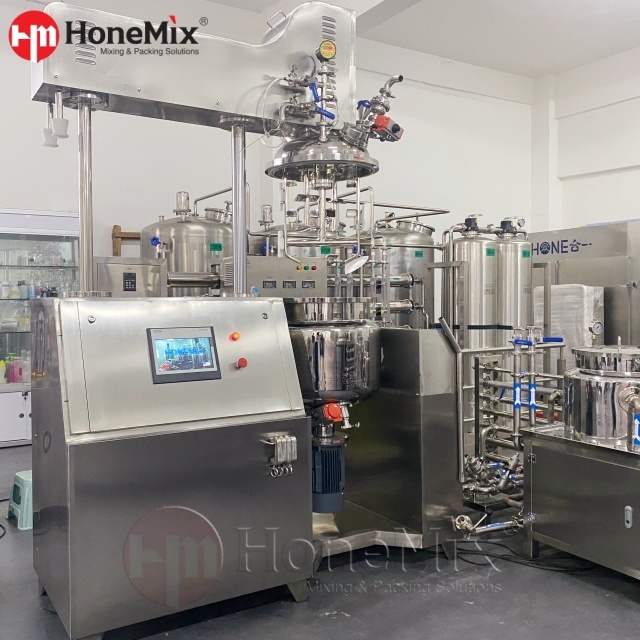
The Crucial Role of the Vacuum Emulsifying Mixer in Complex Formulations
High-shear mixing naturally creates an intense fluid vortex inside the tank. This powerful fluid motion easily pulls ambient air straight down into the product core. It causes detrimental voids, rapid ingredient oxidation, and highly inaccurate filling weights at the packaging line. Aerated cosmetic creams feel distinctly spongy and unprofessional to the end user. Aerated chemical mixtures oxidize rapidly, ruining their intended efficacy and altering their chemical profile. Volumetric filling machines struggle to dose aerated products accurately, leading to severe compliance issues.
To solve this critical physical issue, integrating a Vacuum Emulsifying Mixer becomes highly essential. This advanced equipment operates strictly under negative atmospheric pressure. It actively de-aerates the mixture during the entire emulsification process. Air bubbles simply cannot survive inside a proper vacuum environment. The sustained vacuum pulls trapped air out of the thickest pastes effortlessly, ensuring a dense, uniform matrix.
This automated de-aeration process drives highly tangible business benefits. You achieve perfectly smooth, premium textures for demanding products like cosmetics, pharmaceutical ointments, or heavy food dressings. Removing oxygen drastically reduces lipid oxidation rates, significantly extending the product shelf life. Furthermore, vacuum processing maintains highly compliant sanitary profiles by completely preventing any airborne contaminant ingress. You ensure the final specific gravity remains exactly on target, perfectly optimizing your high-speed packaging operations.
High Shear vs. Homogenizers vs. Colloidal Mills: A Decision Framework
Comparing equipment types carefully helps buyers disqualify the wrong machinery early in the procurement phase. You need a highly pragmatic rule-of-thumb based on material viscosity (cP), target micron size, and batch turnaround time. Selecting the wrong mixing technology leads to severe production bottlenecks and broken equipment.
Equipment Type | Best Application Focus | Viscosity Handling Range | Target Particle Size |
High Shear Emulsifying Mixer | Rapid dispersion and immiscible liquid emulsification | Medium to High Viscosity | 2 to 10 microns |
High-Pressure Homogenizers | Ultra-fine sub-micron particle size reduction | Low Viscosity Only | Sub-micron (< 1 micron) |
Colloidal Mixers | Extreme mechanical milling for thick materials | Very High Viscosity (Pastes) | 1 to 5 microns |
The high shear option consistently excels at rapid particle dispersion. It emulsifies immiscible liquids rapidly and handles medium-to-high viscosities perfectly. The interchangeable rotor-stator heads give operators immense flexibility across various product lines. You can easily switch from a coarse stator for fast lump reduction to a fine-screen stator for final emulsion polishing.
However, high-pressure homogenizers remain ideal for ultra-fine sub-micron particle reduction. Their main drawback involves exceptionally high energy consumption and frequent, complex seal replacements. They also cannot handle high-viscosity or particulate-heavy suspensions without severe internal valve clogging. Forcing thick gels through a homogenizer inevitably leads to catastrophic pressure drops.
Colloidal mixers suit highly viscous pastes requiring extreme mechanical milling. They physically grind materials between precision-machined interlocking plates. Match your equipment carefully to your actual viscosity limits and your strict target particle size to guarantee long-term production success.
Key Evaluation Dimensions for Procurement
Procuring the exact right machine requires strict, dimension-based evaluation criteria. Look closely at these four key engineering dimensions before finalizing any capital investment:
Rotor-Stator Geometry and Tolerances: The physical gap between the rapidly spinning rotor and the stationary stator dictates your precise shear energy. Tight tolerances generate massive hydraulic shear. You need interchangeable workheads (such as slotted, round-hole, or fine-screen designs) to guarantee process flexibility across different complex recipes.
Scalability Metrics: Moving from a small lab-scale (800ml) mixer to full production volumes requires highly predictable scaling mathematics. Your rotor tip speed (measured in meters per second) must remain mathematically constant. Constant tip speeds guarantee perfectly repeatable results regardless of the final scaled batch volume.
Compliance and Sanitary Design: Strict equipment hygiene matters deeply in regulated industries. Look specifically for clean-in-place (CIP) spray balls and sterilize-in-place (SIP) capabilities. Demand FDA-compliant internal elastomers and completely crevice-free electropolished 316L stainless steel contact parts to eliminate bacterial harboring points.
Automation and Data Logging: Strict batch traceability ensures long-term quality control. Integrated PLC controls with HMI touchscreens help you monitor exact RPM, negative vacuum levels, and internal temperature continuously. Automated data logging protects your facility directly during rigorous compliance audits.
Implementation Realities: Managing Heat, Viscosity, and Maintenance
Acknowledge mechanical equipment limitations early in the facility design phase. Maintaining a skeptical, highly trustworthy approach prevents costly post-installation surprises. First, consider strict thermal management. High shear generates significant kinetic heat through intense fluid friction. This continuous heat can degrade sensitive active ingredients very quickly. You must specify jacketed cooling vessels. Circulating chilled water through the external jacket actively prevents thermal degradation during extended processing runs.
Second, deeply understand your material viscosity thresholds. Standard high-shear workheads cannot pull extremely thick materials independently. At higher viscosities, you require an auxiliary anchor scraper fitted with flexible Teflon blades. A heavy-duty coaxial agitator effectively feeds the dense product directly into the central high-shear workhead. This prevents the high-speed rotor from simply spinning uselessly inside an empty air cavity.
Third, address internal wear parts realistically. Avoid trusting "maintenance-free" marketing claims entirely. Double mechanical seals operating under strict vacuum conditions experience natural friction wear over time. Pumping abrasive raw materials accelerates this mechanical degradation significantly. You must carefully plan for routine inspection of the stator gap and mechanical seal barrier fluid levels. Understand the mechanical realities of spare parts availability to actively minimize any costly production downtime. Replacing worn seals promptly ensures your vacuum pressure remains highly consistent batch after batch.
Next Steps: Structuring Your Pilot Test
Before finalizing any major equipment purchase, buyers should firmly demand a comprehensive pilot test. Testing basic water or standard Newtonian test fluids proves absolutely nothing about real-world machinery performance. You need a strict proof of concept utilizing your exact proprietary formulation.
Instruct your engineering team to measure these specific key performance indicators (KPIs) during the factory pilot test:
Processing Time Durations: Track exactly how long it takes the machine to reach full visual and measurable dispersion.
Final Particle Size Distribution (PSD): Verify droplet uniformity via strict laboratory laser diffraction analysis. Do not rely on basic visual checks alone.
Thermal Temperature Spikes: Monitor internal heat generation continuously to ensure the specified cooling jacket functions properly under maximum load.
Vacuum Hold Integrity: Ensure the mixing chamber maintains negative pressure perfectly without leaking ambient air during the peak shear mixing phases.
By structuring the pilot test rigorously, you validate the mechanical equipment capabilities directly against your actual, real-world production needs.
Conclusion
Let us review the fundamental principles of achieving optimal product dispersion and stability for complex formulations.
Matching the exact right shear energy to the corresponding processing environment remains strictly essential for commercial success.
For highly sensitive or physically dense formulations, investing in specialized vacuum processing proves the most reliable path to repeatable, premium quality.
Routine, proactive maintenance of rotor-stator gaps and mechanical seals actively prevents unplanned production stops and protects product integrity.
Demanding a rigorous pilot test using actual product formulations guarantees the equipment actually meets your precise viscosity and particle size requirements.
Process engineers should consult directly with experienced equipment manufacturers today. Share your specific viscosity limits and strict particle size targets clearly. Request a customized, highly detailed equipment specification sheet to start your facility upgrade journey with absolute confidence.
FAQ
Q: What is the maximum viscosity a high shear emulsifying mixer can handle?
A: These machines realistically handle viscosities up to 50,000–100,000 cP. However, treating higher viscosities safely requires supplementary slow-speed anchor agitation. This auxiliary scraper feeds thick materials continuously into the workhead and effectively prevents destructive cavitation.
Q: How does a vacuum emulsifying mixer improve product shelf life?
A: Removing oxygen from the mixing chamber heavily limits aerobic bacterial growth. It also severely restricts lipid oxidation in sensitive ingredients. Furthermore, eliminating trapped micro-bubbles prevents physical phase separation over time, ensuring a highly stable final product.
Q: Can a high shear mixer replace a high-pressure homogenizer?
A: Yes, it can replace a homogenizer if your target particle sizes remain between 2 to 5 microns. No, it cannot replace one if your formulation strictly requires sub-micron nano-emulsions. High shear often serves as a highly necessary pre-mixing step before homogenization.
Q: What is the typical maintenance cycle for the rotor-stator workhead?
A: The wear cycle depends entirely on the abrasiveness of your specific raw materials. Regular physical inspection of the mechanical seal and the precision stator gap is strictly required. Maintaining these tight physical tolerances guarantees optimal dispersion efficiency over time.


