Batch processing facilities face a severe operational bottleneck every single day. Downtime during routine sanitation severely limits your overall production capacity. Cross-contamination risks increase sharply when switching between complex chemical formulas. Fixed-tank systems often trap sticky residues in hard-to-reach internal areas. Operators spend excessive hours scrubbing wall scraper blades and tiny rotor-stator gaps. This tedious manual intervention delays production schedules considerably. It also directly threatens strict Good Manufacturing Practice (GMP) compliance.
We will explore how a mechanically raised lid and exposed agitation assembly solve this distinct challenge. You will learn how a modern structural approach transforms standard daily operations. By pairing high-shear processing with a powered vertical lift, facilities can achieve much faster cleaning and formula changeover. This engineering upgrade enhances sanitation protocols without sacrificing essential product quality. It acts primarily as an efficiency upgrade designed specifically to reduce labor hours between successive batches.
Key Takeaways
Unhindered Access: Hydraulic lifting mechanisms provide 100% visual and physical access to the tank interior, eliminating cleaning blind spots associated with fixed-lid mixers.
Changeover Speed: Wide lifting strokes and up to 90-degree tank tilting drastically reduce turnaround times between different emulsion batches.
Safety & Compliance: Built-in physical interlocks prevent lifting under vacuum and ensure safe operator conditions during manual swabbing or CIP (Clean-in-Place) procedures.
Material Limitations: While ideal for high-viscosity creams and lotions, these mixers are not suitable for highly abrasive materials that can degrade food-grade scrapers.
The Hidden Cost of Fixed-Tank Mixers in Multi-Product Facilities
Manual cleaning creates a massive hurdle in modern multi-product facilities. Operators struggle daily inside fixed-tank homogenizers due to severely cramped access. They face poor visibility and awkward working angles. They often leave uncleaned residue behind unintentionally. This unseen buildup easily compromises subsequent product batches. The margin-killing reality becomes obvious when you calculate the extended downtime required for manual verification. Facilities lose valuable production hours simply washing and inspecting stainless steel walls.
High-viscosity products pose a unique cross-contamination risk. Heavy creams and thick ointments cling stubbornly to internal processing components. They pack deeply into the narrow rotor-stator gap of the bottom homogenizer. They stick tightly to the rear edges of scraper blades. These dense materials resist standard flushing procedures. Operators must perform meticulous manual verification to ensure absolute cleanliness. They swab hidden corners repeatedly to guarantee basic hygiene standards.
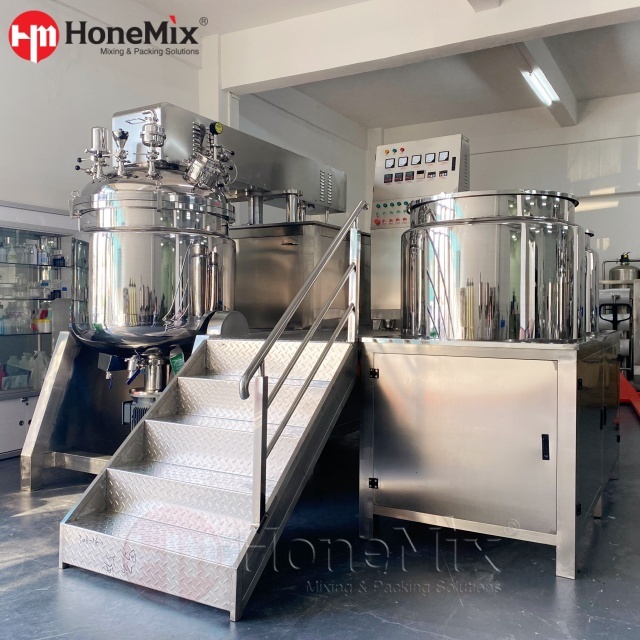
We see a much better alternative in hydraulic transmission technology. Facilities can upgrade to a Vacuum Emulsifying Mixer equipped with a specialized hydraulic lifting mechanism. This system relies on simple fluid incompressibility to generate movement. Hydraulic fluid pushes against a specialized piston cylinder. It provides a smooth, high-torque vertical lift. The system features self-locking capabilities to prevent sudden drops. The lift raises the entire agitation system safely out of the main vessel. You gain immediate, fully exposed access to every internal surface.
How Hydraulic Lifting Accelerates Cleaning and Formula Changeovers
Operators clean processing equipment much faster when they can see everything clearly. An extended vertical stroke raises the entire mixing array above the tank. You can safely inspect components previously hidden by the heavy lid. You easily reach the underside of the cover and the inner mixing paddles.
Total Visibility & Swab Testing
Physical barriers vanish completely when the lid rises. Quality control teams conduct swab tests rapidly without leaning into confined spaces. They visually confirm the absence of cross-contamination immediately. The extended vertical stroke allows operators to safely inspect previously hidden components. You easily check the underside of the lid and the complex inner mixing paddles. This total visibility ensures compliance with the strictest pharmaceutical and cosmetic regulations.
Teflon Scraper Maintenance
The fully exposed state simplifies routine maintenance procedures significantly. You can detach food-grade PTFE (Teflon) wall scrapers easily. Operators unclip these components by hand. They clean or replace the scrapers thoroughly before running a completely new formula. Food-grade PTFE resists chemical degradation effectively. However, you must keep the scraper edges pristine to maintain efficient heat transfer along the jacketed vessel walls.
Streamlined Discharging (90-Degree Tilting)
Viscous pastes naturally resist gravity flow during the discharge phase. You solve this frustrating issue by pairing a hydraulic lift with a tilting main pot. The tank pivots on a sturdy trunnion axis. It tilts up to 90 degrees forward. This allows rapid gravity-assisted discharging of high-viscosity pastes. Less residual product remains stuck inside the tank. Operators spend less time cleaning leftover paste, significantly accelerating batch transitions.
CIP/SIP Integration
Lifting systems complement automated sanitation protocols perfectly. Built-in Clean-in-Place (CIP) spray balls operate more effectively in open configurations. You can run automated flushing cycles with the lid partially raised. This exposes overlapping joints to the high-pressure water stream. Facilities integrate Sterilization-in-Place (SIP) routines easily. This guarantees validated, repeatable sanitation cycles every single time.
Anatomy of a Quick-Change Vacuum Emulsifying Mixer
Modern emulsification relies on precisely engineered, highly polished components. We must understand exactly what the hydraulic system lifts away from the batch. The lid houses a complex sensor array. The internal vessel contains a highly specialized agitation system. Every part plays a crucial role in maintaining vacuum integrity and mixing efficiency.
The Lid & Sensor Array
The heavy stainless steel lid carries critical process instrumentation. The hydraulic system lifts all these parts simultaneously out of the product zone. We break down these vital components below:
Sight Glass: Provides real-time visual monitoring of the vortex. Usually includes a built-in LED scraper or wiper.
Vacuum Pressure Gauges: Display real-time negative pressure values to prevent seal failure.
Air Filters: Ensure ambient air drawn into the tank remains sterile and particulate-free.
Micro-aeration Valves: Control precise air injection for specialized lightweight cosmetic formulas.
Spice/Essence Funnels: Allow direct dosing of sensitive fragrances without breaking the main vacuum seal.
The Triple Agitation System
The internal triple agitation system handles the actual heavy lifting of product blending. A low-speed outer scraper rotates constantly along the vessel wall. It prevents edge build-up and pushes cool material downward. A central paddle rotates in the opposite direction to mix the bulk volume. The bottom-mounted high-shear homogenizer performs the hardest physical work. It utilizes a precision rotor and stator. This unit mills solid particles and oil droplets aggressively down to 0.2–2μm.
Surface Finish Standards
Reputable equipment relies heavily on strict surface finish standards. Contact parts use premium SS316L stainless steel exclusively. The internal surfaces feature an exceptional mirror polish of Ra < 0.8μm. Some manufacturers rate this high-grade finish as 300 MESH. This ultra-smooth surface inherently resists material adhesion. It ensures heavy creams slide off the metal easily during the discharge phase.
| | Table 1: Key Components of the Hydraulic Agitation Assembly |
Component Category | Specific Part | Primary Function |
Lid Assembly | Vacuum Pressure Gauge | Monitors negative pressure during defoaming cycles. |
Lid Assembly | Essence Funnel | Allows safe addition of trace elements mid-process. |
Agitation System | PTFE Wall Scraper | Prevents material burn-on and improves heat transfer. |
Agitation System | Rotor-Stator Homogenizer | Reduces droplet size to create stable emulsions (0.2–2μm). |
Safe Operating Procedures (SOP) for Batch Transitions
You must follow strict standard operating procedures during all batch transitions. Hydraulic lifts introduce heavy moving parts into the processing area. Facilities rely on structured workflows to protect operators and machinery alike.
1. Pre-Run Preparation
Operators initiate the process sequence using a simple "One-Button Down" control. The hydraulic descent lowers the heavy lid smoothly onto the main vessel. Workers verify the mechanical clamping process visually and physically. They secure the tank fully prior to drawing a negative vacuum. A compromised seal will ruin the batch and damage the vacuum pump.
2. Active Processing (Temperature Control)
Emulsification requires highly precise thermal management. Optimal emulsification ranges usually sit between 60°C and 80°C. You use jacketed heating and cooling to regulate the internal batch temperature. Proper temperature control prevents premature emulsion breaking or droplet coalescence. Operators monitor the integrated digital thermometers closely during the high-shear phase.
3. Safety Interlocks (Poka-Yoke Design)
Good industrial design always anticipates human error. Crucial fail-safes protect the operator during busy production shifts. We call this Poka-yoke design. The lid simply cannot lift if the tank remains under negative pressure. The agitator motor automatically cuts power immediately when the lid unseals. These physical interlocks ensure safe operator conditions during manual swabbing.
4. Post-Run Setup
You initiate the automated "One-Button Up" sequence only after venting the vacuum completely. The hydraulic system lifts the lid clear of the tank. Operators perform residual drainage immediately using the 90-degree tilt function. They start initial flushing protocols before the chemical product hardens on the steel. Quick action prevents extended cleaning delays.
Equipment Limitations and Evaluation Criteria
No single industrial machine solves every processing challenge perfectly. You must understand exactly where a Hydraulic Lifting Vacuum Emulsifier falls short. We prioritize transparency in equipment evaluation to help you make informed decisions.
Where Hydraulic Mixers Fall Short (Transparency)
Abrasive Ingredients
Abrasive ingredients pose a specific mechanical threat. Suspended hard particulates rapidly wear down the delicate wall-scraping mechanism. The Teflon blades degrade quickly when pushed against rough, sandy materials. This degradation introduces plastic particulate contamination into your product. You should avoid these batch mixers if your formula relies heavily on harsh physical exfoliants.
Thermal Sensitivity
Thermal sensitivity creates another significant process challenge. High-shear friction generates intense inherent heat during emulsification. The rotor-stator acts like a mechanical heater. Formulas highly sensitive to temperature spikes require strict chiller integration. You must control the cooling jacket aggressively to prevent ingredient degradation.
Batch vs. Inline Decision Logic
Hydraulic batch mixers handle ultra-high-viscosity materials perfectly. They suit multi-formula facilities requiring frequent ingredient changeovers. Inline homogenizers operate quite differently. They suit continuous, single-product liquid streams. Inline units process lower-viscosity liquids efficiently over long runs but fail miserably with stiff pastes.
| | Table 2: Comparison Chart - Batch vs. Inline Decision Logic |
Evaluation Criteria | Hydraulic Batch Mixer | Inline Homogenizer |
Optimal Material Viscosity | High to Ultra-High (Creams, Pastes) | Low to Medium (Lotions, Liquids) |
Production Style | Multi-formula, frequent changeovers | Continuous, single-product streams |
Cleaning Accessibility | Excellent (Fully exposed via lift) | Moderate (Relies heavily on CIP pumping) |
Vacuum Defoaming | Built-in directly to the main vessel | Requires separate vacuum deaerator unit |
Shortlisting Criteria for Buyers
Buyers need clear shortlisting criteria before requesting quotes. You should evaluate the maximum lifting height carefully. Compare it strictly against your facility ceiling constraints. A machine that hits your roof line becomes useless. Verify operating noise levels for long-term operator comfort. The machine should run below 75dB under normal load. Check the main control panel for standardized electrical components. Insist on reliable, globally supported brands like Siemens, Schneider, or Festo.
Conclusion
Upgrading your facility setup serves primarily as a massive investment in uptime and sanitation certainty. The mechanical advantage of exposing the entire agitation system fundamentally changes how operators handle daily maintenance. Facilities facing frequent batch transitions must prioritize equipment equipped with robust safety interlocks and certified internal polishing standards. These specific features directly mitigate human error and material adhesion.
We recommend buyers take a highly proactive approach during procurement. Request a documented test run or Factory Acceptance Test (FAT) prior to delivery. Use your specific high-viscosity materials during this testing phase. This practical step allows you to verify exact discharge rates and cleaning times in a controlled environment.
FAQ
Q: Does a hydraulic lifting lid compromise the vacuum seal?
A: No. High-quality systems use robust O-rings and mechanical locking clamps. Furthermore, safety interlocks prevent the machine from drawing a vacuum unless the lid is perfectly seated and locked.
Q: How long does a typical formula changeover take with a hydraulic system?
A: While dependent on the product, the ability to fully elevate the mixing head and tilt the pot can reduce manual cleaning and inspection times by 40-60% compared to fixed-tank models.
Q: Can a vacuum emulsifying mixer handle solid fat and wax melting?
A: Yes, provided the system includes jacketed heating (water, oil, or steam) and operators manage the temperature curve carefully (typically up to 80°C for standard cosmetic phases) before initiating high-shear homogenization.
Q: What is the minimum batch size for a hydraulic vacuum mixer?
A: Generally, batch mixers require the material to cover the bottom-mounted homogenizer and reach the lowest scraper blade. Depending on the vessel size, this typically means a minimum working volume of 20% to 30% of the total tank capacity.


