Formulating cosmetics is an exacting science. Yet, even the finest ingredients fail if the mixing process introduces hidden flaws. High-viscosity formulations often suffer from trapped air, rapid oxidation, and unexpected phase separation when you process them under normal atmospheric pressure.
These hidden defects compromise overall product stability. They also degrade sensitive active ingredients, which remain crucial in today's demanding "clean beauty" market. Furthermore, trapped air causes downstream filling volume discrepancies. When air escapes inside a sealed jar, the product shrinks. You then face strict regulatory non-compliance and costly product returns.
Upgrading to a Vacuum Emulsifying Mixer solves these critical issues mechanically. This advanced equipment combines deep vacuum deaeration with intense high-shear homogenization. In this guide, you will discover exactly how this technology ensures a flawless, stable texture for any product formulation.
Key Takeaways
Operating under vacuum (down to 40mbar) prevents micro-bubbles, protecting against oxidation and ensuring precise volumetric filling.
Rotor-stator homogenization can reduce particle sizes to 2 microns, guaranteeing long-term emulsion stability without phase separation.
Selecting the correct homogenizer placement (top, bottom, or planetary) depends entirely on the product’s specific viscosity range (e.g., 10,000 to 100,000 cps).
Enterprise-grade machines reduce downtime through integrated hydraulic lifting, Clean-in-Place (CIP) systems, and IQ/OQ validation support.
The Business Case: Why Atmospheric Mixing Fails for High-Viscosity Cosmetics
Manufacturers often underestimate the sheer physical resistance of thick materials. Relying on standard open-air vessels creates massive production bottlenecks. You must address these physical limitations to scale your cosmetic or pharmaceutical production profitably.
The "Debubbling" Bottleneck
Standard atmospheric mixers rely entirely on natural buoyancy for air escape. In thin liquids, bubbles rise quickly. In thick materials, they simply do not. Natural air escape in heavy formulations takes hours or even days. This waiting period paralyzes your factory floor.
Vacuum environments change this dynamic completely. A powerful pump actively pulls air out of the product matrix during the blending phase. You eliminate the idle resting time entirely. As soon as the blending cycle finishes, the batch is ready. You can transition immediately to the packaging stage.
Filling Compliance Risks
Trapped air creates an illusion of volume. Micro-bubbles suspended in a thick gel will hold their shape temporarily. However, they will eventually collapse during transit or storage.
This collapse causes the total product volume to shrink inside the jar. A container might leave your facility looking full but arrive half-empty on the retail shelf. This leads directly to net-weight compliance failures. Regulatory bodies frequently penalize brands for under-filling. Moreover, consumers will return products if they feel cheated by partially filled jars. Removing air proactively prevents these expensive packaging discrepancies.
Clean Beauty & Preservation
Consumer preferences now drive the industry heavily toward organic formulations. Modern buyers demand fewer synthetic preservatives. They want natural plant extracts and delicate peptides.
These natural ingredients are highly susceptible to oxidation. When you mix them in open air, oxygen degrades their chemical structure rapidly. Vacuum processing minimizes oxygen exposure drastically. You protect the integrity of your active botanical extracts. By removing the oxygen, you inhibit aerobic bacterial growth. This extends the organic shelf life naturally, allowing you to meet clean beauty standards.
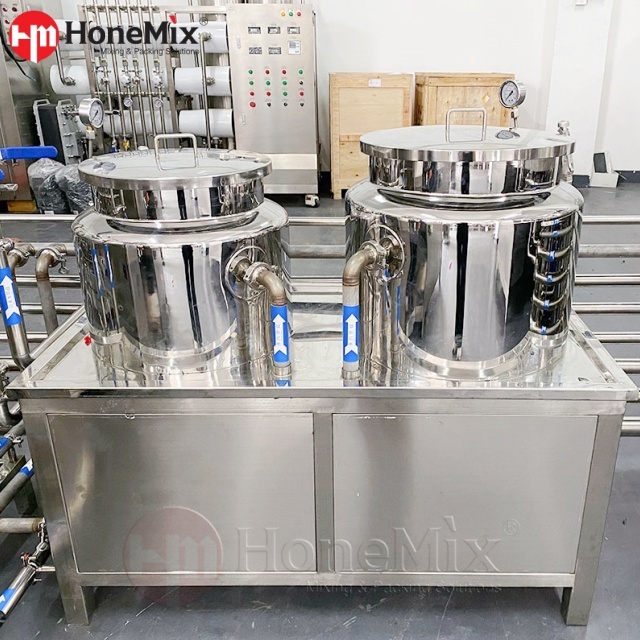
Core Mechanical Features That Dictate Emulsion Quality
A high-performance blending unit relies on sophisticated engineering. You cannot achieve perfect micro-emulsions through simple paddle stirring. You need dedicated mechanical components working in harmony.
High-Shear Rotor-Stator Systems
The heart of the emulsification process is the rotor-stator workhead. It does not merely stir the liquid. It physically tears the oil and water phases apart.
Intense centrifugal forces pull the raw materials into the center of the workhead. The spinning rotor pushes the fluid outward at tremendous velocities. The fluid then hits the stationary stator screen. This impact creates immense hydraulic shear. It shatters the droplets into uniform sub-micron particles. Your target is typically around 2 micrometers. Achieving this tiny particle size guarantees a smooth, luxurious texture that will not separate over time.
Counter-Rotating Agitators with Scrapers
While the rotor-stator handles micro-shearing, the macro-blending requires complex fluid dynamics. Advanced tanks utilize counter-rotating agitators to prevent material stagnation.
The inner blades rotate clockwise, pushing the material downward. Simultaneously, the outer frame agitators rotate counter-clockwise, pulling the material upward. This creates a continuous, dynamic vortex. Furthermore, the outer frame features hinged Teflon scrapers. These scrapers constantly sweep the inner tank walls. They scrape away thick material buildup. This mechanical wiping prevents a stagnant thermal layer from insulating the tank walls.
Precision Temperature Control
Emulsions require exact thermal manipulation. Heating reduces the raw material viscosity, making it easier to emulsify. Operators typically use steam, hot water, or thermal oil inside the vessel jacket.
Once the high-shear phase completes, you must cool the batch rapidly. Rapid jacketed cooling locks in the newly formed emulsion network. If you leave the batch hot for too long, sensitive active ingredients will degrade. The Teflon scrapers ensure the cold tank walls maintain direct contact with the bulk fluid. This maximizes thermal conductivity and slashes your cooling cycle times dramatically.
Matching the Vacuum Emulsifying Mixer to Your Formulation
No single hardware configuration works universally for all formulas. You must tailor the machine's architecture to the specific physical traits of your product line.
Formulation Viscosity Chart
Consult this reference chart to map your product type to the correct homogenizer placement.
Viscosity Range (cps) | Product Example | Recommended Homogenizer Type | Primary Fluid Dynamic |
1,000 - 10,000 | Light Serums & Toners | Top-Mounted | Vortex drawing down |
10,000 - 50,000 | Lotion & Hand Creams | Bottom-Mounted | Upward forced circulation |
50,000 - 100,000+ | Heavy cream & Wax | Planetary Vacuum | Complete spatial sweeping |
Low to Medium Viscosity
For highly fluid mixtures like serums and lotions, top-mounted homogenizers are completely sufficient. Because the material is relatively thin, shear forces propagate easily throughout the entire vessel. The internal vortex quickly pulls surface powders down into the shearing head.
High Viscosity
When producing a dense ointment, fluid dynamics change. Heavy materials naturally settle at the bottom of the tank. They resist being pulled upward. Therefore, bottom-mounted homogenizers are strictly required. They apply immediate, high-impact shear right where the heaviest materials gather. This prevents unmixed lumps from forming near the discharge valve.
Ultra-High Viscosity
Some formulations act almost like solids at room temperature. Think of thick hair clay or waterproof mascara. These materials exceed 100,000 cps. Standard agitators will simply carve a tunnel through the mass, leaving the edges unmixed. Planetary vacuum mixers solve this. Their mixing blades revolve around their own axes while orbiting the tank. This provides completely dead-spot-free mixing for ultra-dense compounds.
Batch vs. Continuous Processing
You also need to decide on the processing style. Batch processors are ideal for versatile cosmetic lines. If you run fifty different SKUs a month, you need a batch tank. You can clean it and switch recipes frequently.
Conversely, continuous inline mixers suit dedicated, high-volume operations. If a pharmaceutical plant produces only one type of healing salve, a continuous flow system maximizes daily tonnage. It eliminates the time wasted loading and unloading individual batches.
Implementation Realities: Automation, Cleaning, and Compliance
Installing industrial mixing equipment involves more than just plugging it in. You must integrate it into your facility's daily workflow, sanitation protocols, and quality control systems.
Sanitation & Turnaround Time
Cleaning thick, sticky residues by hand is grueling. It also invites human error and microbial contamination. Modern production demands automated sanitation.
Highlight the necessity of hydraulic lid lifting. Pressing a button raises the entire upper assembly, exposing the agitators fully. You pair this physical access with automated Clean-in-Place (CIP) and Sterilize-in-Place (SIP) spray balls. These high-pressure nozzles blast hot water and sanitizing chemicals into every corner. They guarantee repeatable cleanliness without dismantling the heavy machinery.
Process Automation Sequence
Manual operation causes batch-to-batch inconsistency. Implementing industrial automation ensures every product meets strict parameters.
Here is how a standard automated sequence operates using modern PLC controls (e.g., Siemens or Delta) and integrated load cells (e.g., Mettler-Toledo):
Phase Weighing: Integrated load cells measure precise amounts of raw materials entering the water and oil pre-mix tanks.
Vacuum Transfer: The PLC triggers the main vacuum pump, drawing the heated pre-mixed phases seamlessly into the main emulsification vessel.
Automated Emulsification: Variable frequency drives spin up the rotor-stator to a pre-programmed RPM for an exact duration.
Controlled Cooling: Temperature sensors command the jacket valves to release steam and inject chilled water at a specific decline rate.
Discharge: The system equalizes tank pressure and activates the discharge pump to feed the packaging line.
This automated, repeatable recipe execution removes operator guesswork entirely.
Regulatory Validation (IQ/OQ/PQ)
Compliance is mandatory for pharmaceutical and GMP-certified cosmetic facilities. Hardware alone is not enough. You need rigorous documentation.
Your equipment must come with Installation Qualification (IQ) and Operational Qualification (OQ) protocols. These documents prove legally that the machine was installed correctly and performs exactly as specified. Without this vendor-supplied validation support, your facility will fail regulatory audits.
Shortlisting Logic & Procurement Checklist
Buying complex industrial machinery requires careful facility planning. Use a structured approach to avoid unexpected installation roadblocks.
Scalability Limitations
Always pilot your formulas before scaling up. We advise starting with benchtop or lab-scale models ranging from 5L to 30L. However, you must ensure these small units share the exact geometric and shear scaling factors as your targeted production models.
If the lab unit uses a different rotor tip speed than the 1000L production unit, your formula will fail at scale. Matching the physical geometry guarantees that your lab successes translate directly to the factory floor.
Facility Requirements Checklist
Review your physical plant infrastructure before finalizing any machine specifications:
Ceiling Clearance: Verify your factory height. Hydraulic lid lifts require substantial vertical clearance when fully raised.
Boiler Capacities: Check your facility's steam output. Steam-heated jackets consume significant thermal energy during heat-up phases.
Chiller Output: Ensure your industrial water chiller can handle the rapid cooling demands of the tank jacket.
Doorway Dimensions: Confirm that the crated machine can physically fit through your facility's loading bay doors.
Customization Options
Standard configurations rarely fit niche applications perfectly. Note any specific environmental or ingredient requirements.
If your formula uses highly volatile solvents or alcohol, safety regulations necessitate explosion-proof motors and specialized anti-static wiring. If your raw materials require long melting times, you must add specialized, heated pre-mix tanks for the water and oil phases. Do not force a standard machine to perform highly specialized tasks.
Conclusion
Ultimately, a Vacuum Homogenizer Mixer is not just a blending vessel. It serves as the critical quality control checkpoint for your entire manufacturing process. It dictates your product's texture, guarantees long-term emulsion stability, and ensures strict regulatory filling compliance.
Transitioning from atmospheric stirring to high-shear vacuum processing represents a major operational upgrade. We strongly encourage facility managers and formulation chemists to map their physical requirements carefully. You must match your highest-viscosity product against the vendor’s precise torque and shear specifications. Take the time to evaluate your formulation limits, facility constraints, and automation needs before requesting a final engineering quote.
FAQ
Q: What is the functional difference between a standard mixer and a vacuum homogenizer?
A: A standard mixer uses simple paddle agitation to move fluids slowly under atmospheric pressure. A vacuum homogenizer utilizes a rotor-stator shear mechanism. It operates at high speeds (often 3000+ RPM) to shatter droplets into micro-particles. Additionally, it applies deep vacuum pressure to actively extract air bubbles from the mixture. This dual action guarantees a perfectly smooth, bubble-free emulsion.
Q: Can one Vacuum Emulsifying Mixer handle both liquid lotion and heavy ointment?
A: Yes. Modern machines feature variable frequency drives (VFDs). You can adjust the rotor speed, scraper velocity, and temperature profiles via the control panel. By programming different recipes, you can process highly fluid lotions at lower torque, and switch to high-torque, intense shear settings for heavy ointments within the same vessel.
Q: How does vacuum mixing impact the heating and cooling cycle?
A: Trapped air bubbles act as microscopic thermal insulators inside your product matrix. By eliminating these air gaps through vacuum extraction, the product becomes much denser. This density improves thermal conductivity significantly. Cold or heat from the jacketed walls transfers much faster through a solid fluid mass, shortening your overall batch cycle times.


