Choosing a mascara filling machine is not a matter of selecting the highest advertised speed. The correct machine must match the way a particular mascara formula flows, the dimensions of the bottle and wiper, the required fill tolerance, the number of product changes and the staffing level of the factory. Two brands may sell containers of similar size while needing very different filling conditions because one formula is warmer and more fluid, another contains more wax, and a third uses an unusually narrow bottle opening.
A useful selection process begins with samples and production data, not with a generic catalogue specification. The following framework helps cosmetic manufacturers convert product requirements into a practical equipment specification.
The first task is to describe the mascara as it will actually reach the filling station. A laboratory viscosity value is useful, but it does not tell the complete story. Manufacturers should record the product temperature, time after manufacture, pigment loading, wax system, tendency to trap air and any change in consistency during a production shift. These factors affect the pressure needed to move the product and the way it separates from the nozzle.
Check Rheology Across the Operating Window
Mascara often becomes easier to move while it is being sheared and thickens again at rest. A machine must therefore be tested at the lowest and highest expected operating temperatures. If the formula is acceptable only in a narrow temperature range, the hopper or transfer path may require controlled heating or insulation. The objective is stable viscosity, not excessive warming that could alter the formula.
Ask the equipment supplier to test representative bulk material rather than a substitute of similar appearance. Water or light oil cannot demonstrate nozzle cutoff, pressure stability or air release for a real mascara formula.
Define the Complete Package Set
The bottle is only one part of the package. A mascara line must work with the bottle, wiper, brush, wand, cap and any decorative outer component. Their dimensions and tolerances determine whether automatic feeding, insertion and tightening will be stable. Provide drawings when available, but also provide several production samples from different cartons or moulding batches. Samples reveal variation that a nominal drawing may not show.
Bottle Neck and Internal Geometry
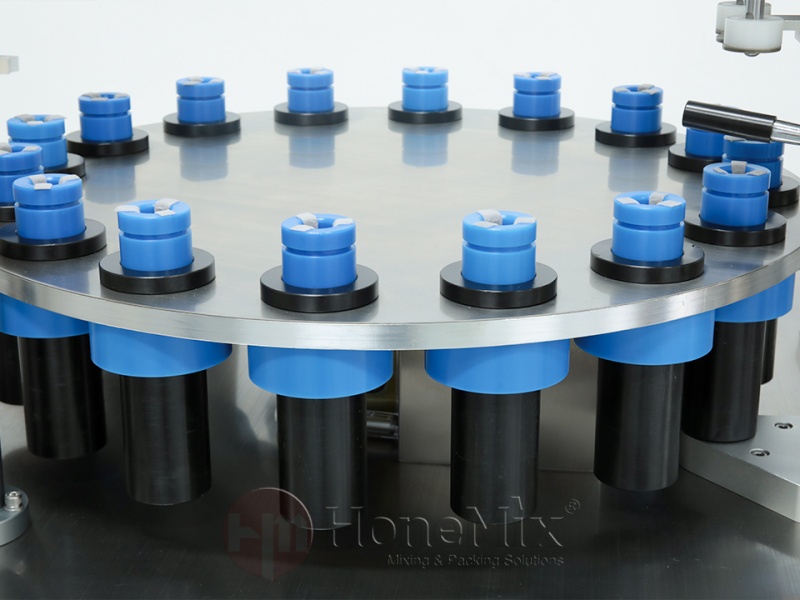
The neck opening must accommodate the filling nozzle and allow air to escape while product enters. A deep, narrow bottle may require a descending nozzle or a slower filling profile. Internal shoulders can trap air or cause product to coat the wall unevenly. Bottle stability on the conveyor also matters; a tall, light container may need a shaped puck or guide to remain upright.
Wiper, Brush and Cap Compatibility
The wiper insertion force and seating depth should be validated because an overly tight wiper can deform or stress the neck. The brush and wand displace product when inserted, so the fill target must leave suitable headspace. Cap thread quality, skirt shape and required torque influence the capping head design. These package details often determine whether a machine can run automatically at the desired speed.
Set a Realistic Output Requirement
Production capacity should be based on good finished units per shift, not only on the maximum mechanical rate. Start with the annual or monthly demand, the number of working days, shift length, planned cleaning time and expected changeovers. Add a reasonable capacity margin, but avoid buying excessive speed that the upstream batch process or component supply cannot support.
For a factory producing small campaigns and many shades, rapid cleaning and changeover may be more valuable than a higher peak speed. A producer running one package for long campaigns may benefit more from automatic component feeding and continuous operation. The correct balance depends on the production mix.
Select the Appropriate Level of Automation
A semi-automatic machine may suit laboratory launches, pilot production or low-volume private-label work. Operators place and remove bottles, while the machine controls the dose. This arrangement is flexible and has a lower entry barrier, but output and consistency depend more heavily on operator rhythm.
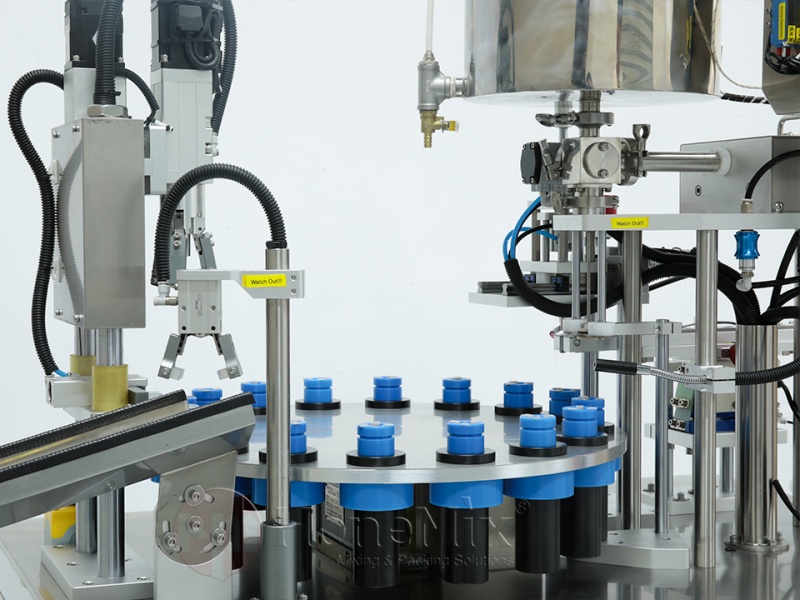
An automatic system can index bottles through filling, wiper insertion, brush placement and capping. It reduces repeated manual handling and can improve traceability, but it requires packaging components that feed reliably. Automatic equipment also needs more careful change-part design when many bottle formats are involved.
Consider who will operate and maintain the line. Automation should reduce routine labour without creating a system that the factory cannot troubleshoot. Clear alarms, accessible parts and practical training are as important as the number of servo axes.
Evaluate the Dosing and Nozzle System
For many thick mascara formulas, piston dosing is a practical choice because it displaces a controlled volume. Servo-driven adjustment can make recipe changes more repeatable and allows different speed phases within a stroke. The machine should provide enough force to move the formula without excessive pressure spikes.
The nozzle must match both the formula and bottle opening. Review nozzle diameter, shutoff design, insertion movement and suck-back control. A good trial should demonstrate clean cutoff at the required cycle rate, not only at slow manual speed. Observe the bottle neck after multiple consecutive cycles and inspect whether strings accumulate on the nozzle exterior.
When reviewing a proposed mascara filling machine, ask how product-contact valves, seals and hoses are selected for the formula. Pigmented products can expose wear or retention points that are less noticeable with clear liquids.
Plan for Cleaning and Product Changeover
Cleaning requirements should be discussed before the machine layout is finalized. Identify which parts contact the product, how they are removed, whether tools are required and where residual mascara can remain. Short, accessible product paths generally simplify cleaning and reduce product loss.
If the factory changes colors frequently, estimate the actual time needed to drain, dismantle, wash, inspect, dry, reassemble and prime the machine. A nominal ten-minute mechanical changeover is not meaningful if sanitation takes two hours. Spare product-contact sets can be useful for rapid campaign changes, but they require controlled storage and identification.
Bottle guides, pucks, wiper tooling and capping heads should be clearly marked for each format. Tool-free adjustments are useful when they remain rigid and repeatable. Position indicators, scales and stored recipes can help operators return to validated settings, but a first-piece check is still required after every changeover.
Review Utilities, Layout and Safety
Confirm electrical supply, compressed-air demand, ventilation, access space and the direction of material flow. The line should allow operators to replenish components and clean the machine without unsafe reaching. Maintenance areas and guard doors need enough clearance. If the machine will connect to upstream transfer equipment or downstream labeling and cartoning, agree on conveyor height, speed signals and accumulation strategy.
Materials of construction should be appropriate for cosmetic production and compatible with the cleaning agents used by the factory. Product-contact surfaces should be smooth and inspectable. Documentation should identify contact materials, recommended seals, lubrication points and maintenance intervals.
Use a Structured Factory Acceptance Trial
A machine trial should reproduce the intended operating conditions as closely as possible. Bring representative product, bottles, wipers, brushes and caps in sufficient quantity for an extended run. A few successful samples do not prove production stability. The trial should include start-up, normal running, a brief stop and restart, low hopper level, component replenishment and a format or recipe change where applicable.
Record fill weights, output, rejects, nozzle cleanliness, wiper seating, cap torque and stoppage causes. Confirm that operators can understand alarms and perform routine adjustments. Any acceptance criteria should be written before the trial so that both parties evaluate the same result.
Questions to Resolve Before Purchase
Before finalizing an order, the manufacturer should know the validated fill range, expected accuracy with the actual product, stable speed with the final package, number of included change parts, cleaning method, spare-parts list and training scope. It should also be clear which future bottle formats can be added and whether they require new feeders, pucks or capping heads.
After-sales support deserves the same attention as machine hardware. Ask how remote diagnosis is handled, which parts are considered critical spares, and what information the supplier needs when a fault occurs. Good support depends on clear drawings, electrical documentation and a machine design that can be diagnosed logically.
Make the Final Decision Around Verified Production Needs
The right filling machine is the one that produces acceptable mascara packages steadily with manageable cleaning, staffing and maintenance. It should be selected around the formula and package, then confirmed through a representative trial. Speed, accuracy and automation claims are useful only when they are tied to defined test conditions.
For companies developing a new mascara line or replacing manual filling, HONEMIX can combine cosmetic processing knowledge with filling and packaging equipment selection. Providing actual bulk material, component samples and target production data allows the equipment configuration to be evaluated against the real application rather than a generic machine description.