Mascara packaging quality cannot be confirmed by checking fill weight alone. A finished unit must contain the correct amount of product, remain clean around the neck, hold the wiper at the proper depth, accept the brush without overflow, close with controlled torque and resist leakage during handling and transport. Because these characteristics are created at different stations, quality control should begin before the first bottle reaches the filling machine and continue throughout the batch.
A practical inspection plan combines incoming component checks, bulk-product release, start-up approval, scheduled in-process sampling and final package tests. The exact limits should come from the product specification and validated process, but the categories below apply to most mascara filling and capping operations.
Inspect Packaging Components Before Production
Many line problems originate in packaging variation rather than in the machine. Bottles, wipers, brushes and caps should be released as a matched set. If components from different suppliers or mould revisions are mixed without testing, the line may show unstable insertion force, poor cap engagement or leakage even though the machine settings have not changed.
Bottle Checks
Inspect the bottle for cracks, chips, contamination, deformation and inconsistent neck dimensions. Measure critical features such as neck inside diameter, thread geometry, overall height and the seating surface used by the wiper. A bottle that is slightly oval can interfere with centering under the filling nozzle or cause uneven wiper insertion.
Wiper, Brush and Cap Checks
The wiper should be free from flash, distortion and contamination. Its outside diameter and retaining features determine insertion force, while the internal opening influences the amount of product removed from the brush during use. The brush and wand should be straight, correctly assembled and compatible with the bottle depth. Caps require inspection for thread damage, liner condition, decoration and dimensional consistency.
Component checks should include an assembly trial. A dimension may be within an individual tolerance but still fail when combined with another component at the opposite end of its tolerance range.
Release the Bulk Mascara for Filling
Before the product is connected to the line, quality personnel should confirm batch identity, appearance, homogeneity and any required laboratory results. The filling team should know the approved temperature range and the maximum holding time before or during packaging. Mascara that has cooled too far, separated or retained excessive air can create filling defects that cannot be solved by adjusting the machine.
A representative sample should be taken according to the site procedure. Visual checks may include color, texture, absence of foreign matter and uniform pigment distribution. Where applicable, viscosity or another rheological measure should be verified using the approved method. The result should be compared at the specified test temperature because viscosity values are not meaningful without controlled conditions.
Approve the Line at Start-Up
Start-up approval should occur after line clearance, cleaning verification, recipe selection and machine priming. The first units are normally produced at reduced speed so that each station can be observed. Inspectors should confirm that the correct bottle, wiper, brush and cap are loaded and that coding or labels, if used on the same line, match the batch documentation.
A start-up sample should be weighed, assembled and examined before normal production begins. When adjustments are made, the previous rejected or trial units must be segregated. The approved settings and sample results should be recorded so that operators have a clear reference for the rest of the batch.
Control Fill Quantity and Repeatability
Net fill quantity is usually checked by weighing an empty container and the corresponding filled container, or by using an established average tare method when component variation is controlled. The test method must account for the fact that mascara adheres to surfaces and cannot be poured out cleanly for a simple volume check.
Quality limits should include both the target and the allowable variation. An average that meets the target can hide individual underfilled or overfilled units. For this reason, record each sample result and review the range or statistical trend. A gradual change may indicate cooling product, air entering the dosing system, seal wear or a changing hopper condition.
When a multi-nozzle machine is used, samples should be traceable to each nozzle. A combined average may hide one nozzle that consistently fills low. Nozzle-specific checks make maintenance and adjustment more efficient.
Verify Fill Level and Headspace
Weight is not the only filling criterion. The product level and headspace must allow the wiper and brush to enter without forcing mascara out of the neck. Inspect units immediately after filling and again after complete assembly. If the final level rises excessively, the fill target may not account for brush displacement or the package dimensions may have changed.
Check Bottle-Neck Cleanliness
Residue on the neck can prevent the wiper from seating, contaminate the cap thread and create an unattractive finished product. Inspect the top surface, inside neck area and external thread after filling. A recurring mark in the same location may indicate nozzle misalignment, while random strings can point to cutoff or product-condition problems.
Cleanliness criteria should be visual and specific. “Acceptable appearance” is difficult to apply consistently, so reference samples or photographs are useful. Manual wiping should not become a routine substitute for correcting an unstable filling process.
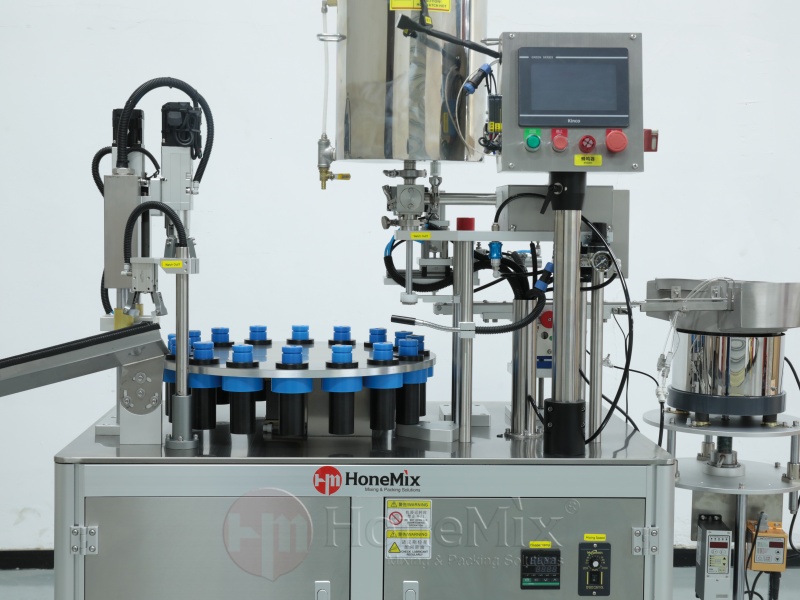
The filling station of a well-configured mascara filling machine should support controlled nozzle movement and cutoff, but the result still requires scheduled inspection with the actual formula and bottle.
Confirm Wiper Insertion Quality
The wiper should be seated evenly at the specified depth without cracks, buckling or visible deformation. Inspect the bottle neck for stress marks or damage caused by excessive insertion force. A height gauge or simple go/no-go fixture can make seating checks more repeatable than visual judgment alone.
Insertion force can also be monitored during equipment qualification or packaging development. A sudden increase may indicate dimensional variation, incorrect orientation or contamination. A very low force can signal an undersized wiper that may loosen or leak. Where the machine has force or position monitoring, alarm limits should be based on validated good assemblies.
Evaluate Brush Insertion and Product Wiping
After the wand is inserted and withdrawn during testing, observe how the wiper cleans the brush and whether the stem carries excessive product. The package should deliver the intended user experience without pulling the wiper out of the bottle. Confirm that the brush does not bottom out, bend or scrape the bottle wall.
Control Capping Torque and Alignment
Capping quality includes alignment, thread engagement, final position and torque. Cross-threaded caps may appear closed but leak or become difficult to open. Inspect the gap between cap and bottle, the alignment of decorative features and any evidence of thread damage.
Torque should be measured with an appropriate tester using a defined method. Application torque and removal torque are related but not identical, so the specification must state which value is being checked and when. Samples should be allowed to rest for the specified period if material relaxation affects the result.
Too little torque can allow loosening during transport. Too much torque can deform the cap, damage the thread or make the product difficult for the consumer to open. Changes in cap material, decoration or liner can affect the correct setting.
Leak testing should represent expected storage and transport conditions. Depending on the package and company standard, checks may include inverted storage, horizontal storage, vibration, pressure or vacuum exposure, and temperature cycling. Inspect for product around the wiper, thread and cap after the test.
Not every leakage problem appears immediately. A package may pass at room temperature and fail after heating, cooling or repeated opening. Qualification testing should therefore cover the intended distribution environment, while routine in-process testing can use a shorter validated method.
Establish Sampling Frequency and Reaction Rules
Samples are commonly taken at start-up, after adjustments, after a stop, at defined time intervals and near the end of the batch. Additional checks are appropriate when a new component carton is opened or when product is added to the hopper. Frequency should reflect process risk, historical performance and production volume.
The quality plan must state what happens when a result is outside the limit. Operators need to stop or contain production, identify the last acceptable check, segregate potentially affected units and investigate the cause. Rechecking one good sample should not automatically release a period of uncertain production.
Use Trends, Not Only Pass-or-Fail Results
Recording actual values helps identify deterioration before a specification is exceeded. Rising fill variation, increasing torque or more frequent neck contamination can indicate wear or process drift. Trend review supports preventive maintenance and better changeover settings.
Maintain Traceability Throughout the Batch
Production records should connect the finished units to the bulk batch, packaging lots, machine recipe, operators, inspection results and any adjustments. When multiple lanes or nozzles are used, lane identification improves investigation. Rejected and reworked units should be controlled so that they do not re-enter the line without authorization.
Quality Is Built Across the Entire Filling Process
Reliable mascara packaging comes from controlling components, bulk product, dosing, wiper insertion, brush placement and capping as one process. The most effective quality checks are those that detect drift early and lead to a defined response. Finished-product inspection alone cannot recover product that has already been filled, contaminated or assembled incorrectly.
For manufacturers establishing a new inspection plan or integrating filling and capping operations, HONEMIX can configure cosmetic production equipment around the actual formula, package components and required quality controls. Equipment trials and clearly written acceptance criteria help ensure that machine capability and factory inspection methods support the same finished-package standard.