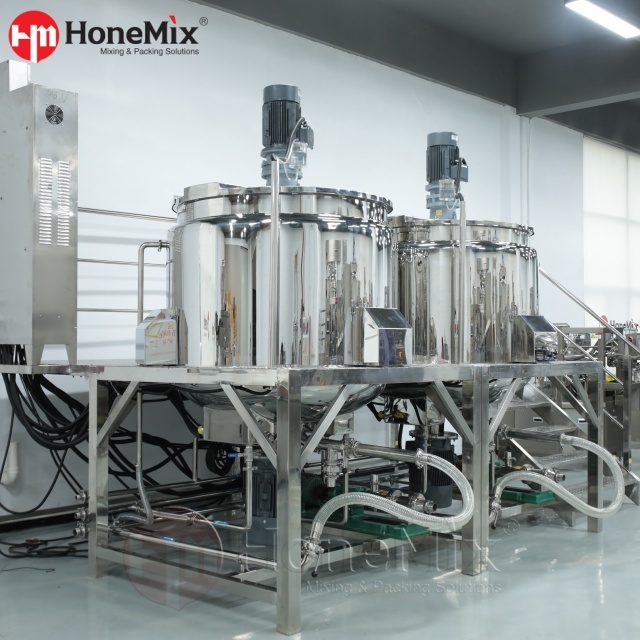
Formulating shampoos means fighting a constant battle between high-shear dispersion and low-shear agitation. You need high shear to break down active ingredients, but that same mechanical force whips surfactants into a massive foam. Standard mixing equipment fails here. When a batch aerates, it expands, cavitates piston fillers, and shuts down packaging lines. The shift toward specialized formulas—like SLS-free, pH-balanced pet washes, and probiotic blends—makes this harder. Natural ingredients like colloidal oatmeal and raw honey drastically alter batch rheology. They demand highly adaptable machinery. Selecting the right manufacturing equipment requires evaluating agitator geometry, thermal control, and de-aeration capabilities. You need a system built to handle shifting viscosities and strict sanitary requirements to ensure repeatable product quality across diverse product lines.
Vacuum integration is mandatory for high-surfactant formulas: Preventing aeration during the mixing phase is significantly more cost-effective than attempting to de-aerate a finished, highly viscous batch.
Dual-agitation systems drive consistency: Combining a slow-speed anchor scraper with a high-shear rotor-stator ensures uniform viscosity without localized overheating, accommodating everything from thin liquid foams to dense shampoo bars.
Thermal management dictates rheology: Utilizing a double jacketed liquid mixing tank allows for precise heating during phase emulsification and controlled cooling to set the final viscosity and protect heat-sensitive natural additives.
Sanitary design mitigates cross-contamination: 316L stainless steel construction with CIP (Clean-in-Place) spray balls is critical for transitioning between different product lines (e.g., standard chemical bases, sulfate-free, or specialized microbiome-friendly pet shampoos).
The Physics of Shampoo Manufacturing: Success Criteria for Mixing
Understanding the fluid dynamics inside a mixing vessel is the first step to optimizing production. Shampoo formulation is an exercise in managing changing physical states. The process begins with water-thin liquids and ends with a dense, non-Newtonian fluid. Equipment must adapt to these changing conditions in real time. If your machinery cannot handle the shifting resistance of the fluid, you will experience motor stalling, incomplete hydration, and ruined batches.
The Surfactant Dilemma and Foaming
Surfactants act as the primary cleansing agents in any shampoo. Traditional ingredients like Sodium Lauryl Sulfate (SLS), Sodium Laureth Sulfate (SLES), and natural plant-based alternatives like decyl glucoside share one common operational trait. They trap air rapidly during agitation. When a standard impeller spins at high speeds, it creates a vortex at the surface of the liquid. This vortex acts like a funnel, pulling atmospheric air directly into the surfactant matrix.
The result is severe volumetric expansion. A 1,000-liter batch can easily expand to occupy 1,300 liters of tank space. This foam does not dissipate quickly on its own. It leads to severe filling-line bottlenecks. When aerated product reaches the filling machine, the pneumatic pistons cavitate. This causes inaccurate dosing, under-filled bottles, and massive amounts of rejected product on the packaging line.
Rheology and Flow Control
Shampoos behave as non-Newtonian fluids. Their viscosity changes depending on the shear stress applied and the chemical reactions occurring within the vessel. During the initial water phase, the fluid offers very little resistance. As thickeners like sodium chloride (salt) or synthetic polymers (like PEG-150) enter the batch, viscosity spikes dramatically. The mixing equipment must handle this transition seamlessly.
If the agitator lacks sufficient torque, the motor will stall out as the product thickens. Conversely, if the shear rate remains too high during the thickening phase, the mechanical force can physically break the delicate polymer chains. This results in a watery final product that fails quality control and cannot be salvaged.
Formulation Variables and Format Challenges
Modern product variations require highly adaptable mixing strategies. Liquid shampoos, pump-foam cleansers, and solid shampoo bars all demand different processing parameters. Hydrating natural thickeners presents a unique challenge on the production floor. Suspending solid particulates like colloidal oatmeal, zinc pyrithione for anti-dandruff formulas, or aloe vera requires precise fluid movement.
If the agitation is too weak, these solids clump together and fall to the tank floor, creating a sludge that never integrates into the product. If the agitation is too aggressive, the botanical structures degrade, losing their efficacy. Specialized pet shampoos often require higher concentrations of these natural soothing agents, complicating the rheology further and demanding precise control over the mixing speed.
Defining Operational Success
A successful tank implementation eliminates these physical bottlenecks entirely. You can measure this success through specific operational metrics on the production floor.
Zero batch rejection due to trapped air or volumetric expansion.
Perfectly homogenous color, fragrance, and active ingredient dispersion without localized clumping.
Predictable and repeatable cycle times for every batch, regardless of the operator on shift.
The ability to transition from a thin, clear clarifying shampoo to a dense, opaque conditioning wash using the same equipment.
Consistent discharge viscosity that allows filling machines to run at maximum rated speeds without recalibration.
Core Agitation and Shear Configurations
Agitation is not just about moving liquid around a vessel. It is about controlling shear rates, managing heat distribution, and preventing material stagnation at the tank walls. A single impeller cannot perform all these tasks simultaneously. High-performance systems utilize multiple agitation zones to handle the complex phases of shampoo formulation.
Anchor Agitators with Teflon Scrapers
Sweep agitation handles the bulk movement of high-viscosity products. An anchor agitator matches the internal contour of the vessel perfectly. It features hinged Teflon scrapers that physically wipe the tank walls as the anchor rotates. This movement pushes highly viscous material away from the heated or cooled walls and folds it back into the center of the batch.
This wiping action prevents thermal degradation, which is especially important for thick, heavy-duty formulations like solid shampoo bars or heavy conditioners. Without scrapers, product burns onto the heating jacket. This ruins the batch and requires hours of manual confined-space cleaning. Variable frequency drives (VFDs) control these anchor agitators. VFDs allow operators to lower the RPMs as the product viscosity increases. Slowing the sweep speed minimizes air entrainment while maintaining bulk fluid movement.
Integrating a Liquid Homogenizer Mixer
Dispersing stubborn powders, hydrating gums, and emulsifying silicones requires extreme mechanical shear. This is where a liquid homogenizer mixer becomes an absolute requirement. Homogenizers force the product through a tight, precision-machined gap between a high-speed rotor and a stationary stator. This action breaks down raw materials at a microscopic level, creating stable emulsions.
Engineers must choose between bottom-entry and top-entry homogenizers. Bottom-entry models are ideal for shampoos because they process the heaviest, most viscous materials at the lowest point in the tank. They easily emulsify silicones and evenly disperse natural additives like honey or botanical extracts into the surfactant base. However, there is a strict trade-off. High shear creates localized heat and potential aeration. Operators must exercise precise control, utilizing the homogenizer only during specific timing windows within the batch cycle, usually before the final thickeners are added.
Contra-Rotating Mixers
For complex, high-yield formulations, contra-rotating mixers offer superior blending capabilities. These systems feature two sets of blades rotating in opposite directions on concentric shafts. The outer anchor moves product inward and scrapes the walls, while inner paddles push product outward. This creates a complex, intersecting flow pattern that rapidly blends disparate viscosities.
Contra-rotating designs eliminate dead zones completely. They are particularly effective when blending heavy conditioning agents or thick waxes into a lighter surfactant base. The opposing forces shear the product gently but thoroughly, ensuring a perfectly uniform mixture in a fraction of the time required by a single-shaft agitator.
Managing Aeration: The Role of Vacuum Systems
Air is the enemy of shampoo manufacturing. Once micro-bubbles become trapped in a high-viscosity fluid, they are incredibly difficult to remove. Atmospheric mixing tanks rely on slow agitation and long resting periods to let air escape naturally. Vacuum-rated vessels solve the problem actively by manipulating the atmospheric pressure inside the tank.
Mechanics of Vacuum Mixing
Drawing a vacuum inside the Shampoo Mixing Tank prevents air from entering the batch in the first place. During powder induction and high-shear phases, the tank operates under negative pressure (typically around -0.09 MPa). Powders can be drawn directly into the fluid below the surface via vacuum suction through a bottom valve or inline eductor.
This eliminates the dusty, air-entraining process of dumping powders through a top manway. The vacuum environment ensures that the vortex created by the homogenizer pulls in liquid, not atmospheric air. By removing the air from the headspace of the tank, you eliminate the primary source of volumetric expansion.
De-aeration of Finished Product
Even with careful processing, some micro-bubbles may form during the chemical reaction of surfactants or during the transfer of raw materials. Vacuum systems excel at active de-aeration. Before the batch is pumped to the holding tank, operators apply maximum vacuum pressure to the vessel.
The negative pressure causes the entrained micro-bubbles to expand in size, rise to the surface rapidly, and burst. The anchor agitator runs at a very low speed during this phase. This gentle folding action continuously exposes new fluid to the vacuum interface at the surface, ensuring the entire batch is de-aerated thoroughly.
Operational Value Analysis
A vacuum-rated vessel requires a heavier steel gauge, reinforced dished heads, and specialized mechanical seals, increasing the initial equipment investment. However, the operational value quickly outpaces this upfront cost. Vacuum mixing eliminates the 24-to-48-hour settling time traditionally required before packaging.
Process Metric
Atmospheric Mixing Tank
Vacuum Mixing Tank
Powder Induction
Manual top-dumping (High dust/air)
Sub-surface vacuum draw (Dust-free)
Aeration Level
High (Requires slow mixing)
Near Zero (Allows high-speed mixing)
Settling Time
24 to 48 hours in holding tanks
Immediate discharge to filling line
Fill Weight Accuracy
Inconsistent due to trapped foam
Highly precise and repeatable
Thermal Control: Engineering the Double Jacketed Liquid Mixing Tank
Temperature dictates viscosity and chemical solubility. Precise thermal management is required to melt solid ingredients, facilitate chemical bonds, and stabilize the final product. A single-wall tank is entirely inadequate for professional shampoo production, as it relies on ambient room temperature, which fluctuates and ruins batch consistency.
Heating for Phase Integration
Many premium shampoos utilize solid surfactants, waxes, fatty alcohols, or heavy thickeners. These ingredients must be melted into the water phase before emulsification can occur. A double jacketed liquid mixing tank circulates a heating medium around the inner vessel to transfer heat evenly across the entire wetted surface area.
Facilities typically use steam, hot water, or thermal oil as the heating medium. Steam provides rapid ramp-up times but requires a high-pressure boiler system. Hot water offers gentle, highly controllable heating, which is excellent for sensitive formulas that might scorch. Thermal oil can reach very high temperatures without requiring high-pressure piping, though it cools down much slower than water. The choice of medium heavily influences your batch cycle times.
Controlled Cooling for Viscosity Stabilization and Active Protection
Heating is only half the thermal process. Rapid, controlled cooling is required to "set" the final viscosity of the shampoo. If a batch cools too slowly, polymers may continue to cross-link unpredictably, resulting in a product that is too thick to pump. Furthermore, cooling protects heat-sensitive ingredients.
Essential oils, prebiotics, probiotics, and delicate natural extracts used in premium human and pet care lines suffer thermal degradation if added to a hot batch. The jacket must rapidly drop the batch temperature to a safe zone (usually below 40°C) before these active ingredients are introduced. Shocking the batch with freezing water can cause waxes to precipitate out of solution, so the cooling curve must be programmed and controlled.
Jacket Engineering Design
The physical design of the jacket impacts heat transfer efficiency. Dimple jackets feature a pattern of spot welds that create turbulence in the heating or cooling medium as it flows around the tank. This turbulence increases the heat transfer surface area and efficiency, making it ideal for steam or water. Half-pipe jackets weld a split pipe directly to the vessel exterior in a spiral pattern. This provides excellent structural rigidity for high-pressure steam applications and directs the flow of the medium precisely. Selecting the right jacket geometry ensures rapid temperature shifts and shorter overall cycle times.
Material Standards and Sanitary Compliance
Personal care products are applied directly to the skin, scalp, and hair. The equipment used to manufacture them must meet stringent sanitary standards to prevent microbial contamination and chemical corrosion. A poorly constructed tank will harbor bacteria and rust, contaminating entire product lines.
Metallurgy and pH Sensitivity
A stainless steel mixing tank is the industry baseline, but the specific grade of steel matters immensely. 316L stainless steel is the mandatory standard for all wetted parts (surfaces that touch the product). Shampoos often contain high levels of chlorides (salts) used as thickening agents. Standard 304 stainless steel is highly susceptible to chloride stress corrosion cracking and pitting when exposed to salt over time.
Furthermore, product lines vary drastically in pH. Human skin requires mildly acidic formulas (around pH 5.5), while some dog shampoos lean alkaline. 316L stainless steel contains molybdenum, which provides the necessary corrosion resistance across this broad pH spectrum. The exterior jacket and non-wetted structural supports can utilize 304 stainless steel to optimize equipment costs without sacrificing product safety.
Surface Finish and Polish
Raw stainless steel has microscopic crevices that harbor bacteria and trap product residue. To prevent microbial buildup, the interior of the tank must be mechanically polished. An industry standard for sanitary vessels is a surface roughness (Ra) of less than 0.4 µm. This mirror-like finish ensures that sticky polymers, gums, and dense surfactants cannot cling to the walls. It facilitates rapid, thorough cleaning between batches and prevents biofilm formation.
CIP and SIP Integration
Manual cleaning is dangerous, time-consuming, and inconsistent. Modern tanks integrate Clean-in-Place (CIP) systems. Strategically placed spray balls douse the entire interior with high-pressure cleaning solutions, acids, and sanitizers. Engineering the tank without "dead legs"—sections of piping where fluid can stagnate—is vital.
Effective CIP requires turbulent flow (usually above 5 feet per second) through all piping to scour away residue. This automated cleaning is absolutely necessary when switching from standard chemical formulas to natural, preservative-free, or microbiome-safe batches. Any cross-contamination from a previous batch can ruin the integrity of a specialized product line and lead to costly recalls.
Implementation Risks and Facility Requirements
Procuring new equipment involves aligning the machinery with existing facility infrastructure. Overlooking these engineering realities leads to delayed deployments, blown budgets, and compromised machine performance on the production floor.
Batch Size vs. Cycle Time
Bigger is not always better when sizing a mixing vessel. Manufacturers must frame the decision between buying a larger tank versus optimizing a smaller tank for faster cycle times. A massive 5,000-liter tank takes significantly longer to heat and cool than a 1,000-liter tank due to the surface-area-to-volume ratio.
If the facility's boiler or chiller cannot supply enough energy quickly, the large tank becomes a massive thermal bottleneck. Often, running multiple rapid batches in a highly automated, smaller vessel yields higher daily throughput than waiting on a single massive batch to heat up and cool down.
Utility Requirements
High-performance mixing tanks draw substantial facility resources. Facility managers must evaluate their current utility capacities before installation. High-draw homogenizer motors require robust electrical panels and specific amperage overhead to handle startup spikes. Double-jacketed systems demand adequate chiller tonnage and boiler horsepower to hit target ramp rates.
Failing to upgrade facility utilities to support the new equipment will result in slow ramp-up times, weak shear performance, and frequent circuit breaker trips. You must calculate the total BTU requirements for heating and cooling the specific mass of your largest batch.
Operator Training and Automation
The complexity of dual-agitation, vacuum-rated, thermally controlled tanks requires skilled operation. Relying on manual valve operation introduces severe human error. Operators may open a cooling valve too late, run the homogenizer too long, or pull a vacuum at the wrong phase. Fully automated PLC (Programmable Logic Controller) and HMI (Human Machine Interface) systems mitigate this risk.
Recipe management systems allow process engineers to program exact RPMs, temperature set-points, and vacuum stages. The operator simply selects the recipe and monitors the process. This automation ensures repeatable viscosity control and precise temperature staging, regardless of which operator is running the shift.
Conclusion
Managing foaming and viscosity in shampoo production is impossible with standard agitation. It requires a purpose-built system that perfectly balances shear, sweep, and thermal control. As formulations become more complex, relying on outdated equipment guarantees inconsistent batches, trapped air, and lost revenue on the packaging line.
When evaluating options, match the tank specifications to your most difficult formulation. If you produce thick, sulfate-free natural pet shampoos with suspended solids, prioritize vacuum capabilities, a high-shear rotor-stator, and robust scraper motors. Do not compromise on the metallurgy or the thermal jacket design, as these dictate the lifespan and flexibility of the machine.
Take the following steps to ensure a successful equipment integration:
Request a Factory Acceptance Test (FAT) using your specific, most challenging formulation to validate viscosity outcomes and motor torque.
Conduct a pilot-scale trial to prove the system's de-aeration capabilities before committing to a full-scale production vessel.
Audit your facility's current boiler, chiller, and electrical capacities to ensure they can support the new equipment's utility demands.
Specify 316L stainless steel for all wetted parts and verify the surface polish meets sanitary requirements via documentation.
Implement a fully automated PLC system to lock in recipe parameters and eliminate operator error during complex heating and cooling phases.
FAQ
Q: Why does my shampoo batch have micro-bubbles, and how does a mixing tank fix this?
A: Micro-bubbles form when surfactants trap atmospheric air during high-speed agitation. A vacuum-rated mixing tank fixes this by operating under negative pressure. It prevents air from entering during powder induction and pulls existing entrained bubbles out of the viscous liquid before the batch is discharged to the filling line.
Q: Do I need a liquid homogenizer mixer for clear shampoos?
A: Not necessarily. Homogenizers are typically required for pearlescent, opaque, or conditioning shampoos that need emulsion and the dispersion of natural additives. Clear shampoos usually only require gentle sweep agitation to blend surfactants and water without generating excessive foam or clouding the product.
Q: How does equipment differ when manufacturing specialized pet shampoos or SLS-free formulas?
A: Specialized formulas use natural thickeners and suspended solids like oatmeal. They require 316L stainless steel for corrosion resistance against varying pH levels. They also demand precise cooling jackets to protect delicate active ingredients and adaptable shear controls to prevent natural solids from clumping during hydration.
Q: What is the advantage of a double jacketed liquid mixing tank over a single wall tank?
A: A double jacketed tank allows for active thermal control. It provides the necessary heat to melt solid surfactants and waxes during the initial phase. It also provides rapid, controlled cooling to set the final product viscosity and protect heat-sensitive additives from thermal degradation before discharge.
Q: How do you mix high-viscosity shampoo without burning it on the tank walls?
A: High-viscosity mixing requires an anchor agitator equipped with hinged Teflon wall scrapers. As the agitator rotates, the scrapers physically wipe the heated tank walls. This constantly moves the thick product back into the center of the batch, preventing localized burning and thermal degradation.
Q: Can a stainless steel mixing tank handle high-salt shampoo formulations?
A: Yes, provided it is constructed from the correct grade of steel. 316L stainless steel is strictly required for wetted parts in high-salt formulations. It contains molybdenum, which prevents the chloride-induced pitting and stress corrosion cracking that would quickly destroy standard 304 stainless steel.
Q: What is the ideal RPM for mixing shampoo to prevent foam?
A: There is no single ideal RPM, as it depends on agitator diameter and real-time product viscosity. Agitation must start faster to blend water and surfactants, then slow down significantly as thickeners are added. Variable Frequency Drives (VFDs) are essential to dynamically adjust speed and prevent foam.