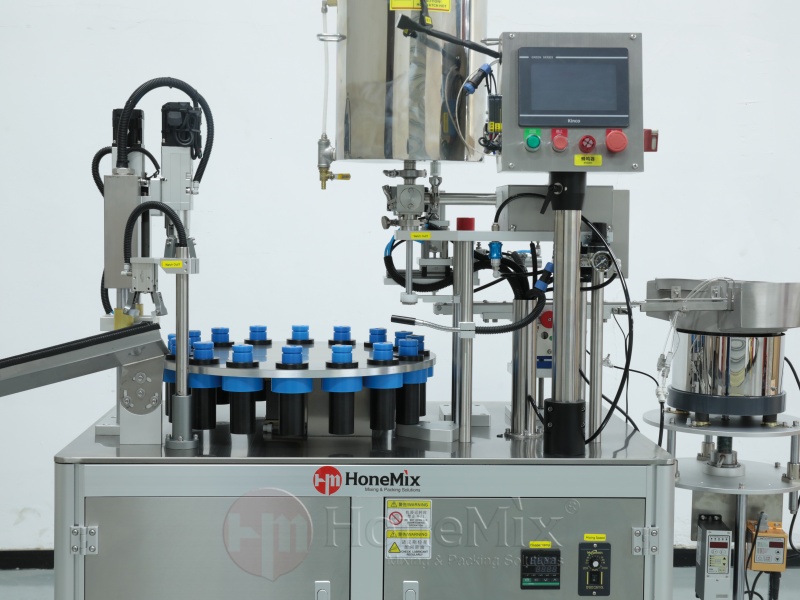
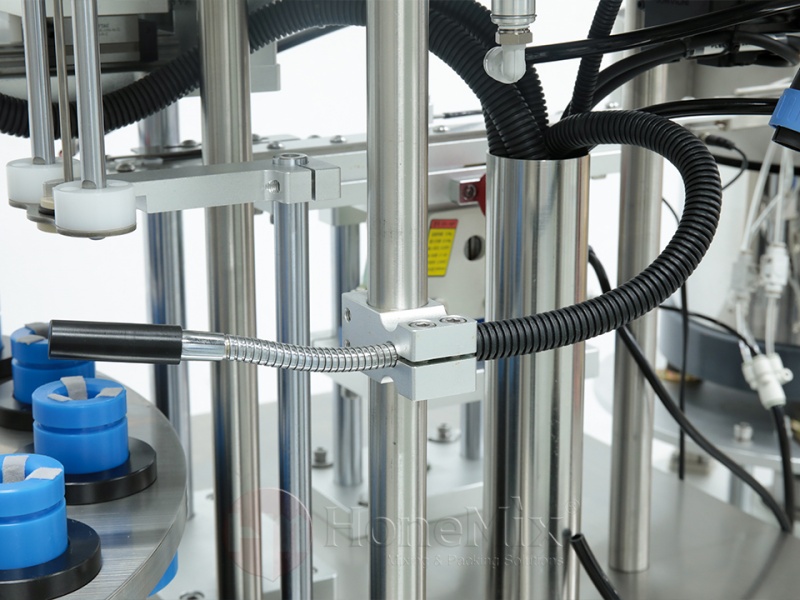
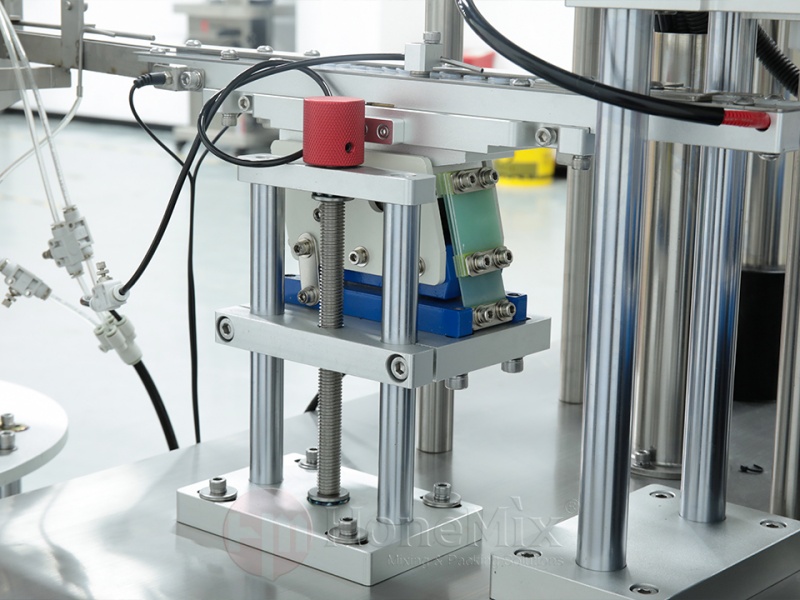
Stringing, dripping and nozzle clogging are among the most visible problems in mascara filling. They can contaminate bottle necks, interrupt wiper insertion, increase product loss and force operators to stop the machine for cleaning. Although the three defects often appear together, they do not always have the same cause. A long product thread may come from poor cutoff, a drop may form because the valve does not close cleanly, and a blockage may develop because the formula cools or dries inside a narrow passage.
Effective correction begins by separating the symptoms, observing when they occur and changing one variable at a time. The objective is not to make the product behave like water. It is to create a stable combination of formula condition, feed pressure, nozzle geometry and machine timing.
First Identify the Defect Correctly
Production teams often use “dripping” as a general description for every dirty-nozzle problem. A more precise diagnosis saves time because each defect points toward a different group of causes.
Stringing
Stringing occurs when a filament of mascara stretches between the nozzle and the bottle as filling ends. The thread may break in the air, wrap around the nozzle or fall across the bottle neck. It is common with cohesive, high-viscosity formulas and becomes worse when the nozzle retracts too quickly or the cutoff speed is poorly tuned.
Dripping
Dripping is the release of a distinct drop after the programmed dose has ended. It can result from product trapped below the shutoff point, residual pressure in the line, worn seals, an insufficient suck-back setting or a valve that closes too slowly. Dripping may continue even when the machine is stopped, which suggests a mechanical sealing or pressure problem rather than only a motion issue.
Clogging
Clogging is a restriction that reduces or stops flow. The obstruction may be hard residue, agglomerated pigment, cooled wax, dried product or foreign material. A partial clog can be harder to notice than a complete blockage because the machine still runs while fill weights gradually drift or one nozzle behaves differently from another.
Keep the Mascara Condition Stable
The machine cannot compensate indefinitely for a formula that changes throughout the shift. Temperature is often the first variable to check. A wax-rich mascara can become noticeably thicker as it cools in the hopper, hose or nozzle. Higher resistance increases pressure, slows the dose and makes the product tail harder to cut. If the process requires a defined temperature window, the bulk product, holding tank and transfer route should all support that range.
Heating should be controlled and validated. Excessive temperature can affect formula stability, solvent loss or packaging performance. The aim is to maintain the approved filling condition rather than to thin the product as much as possible.
Air content also matters. Entrained air compresses under pressure and expands when the valve opens, producing irregular flow and delayed dripping. Gentle transfer, adequate deaeration and a consistent hopper level help reduce this effect. If the first containers after priming contain bubbles or inconsistent weights, the product path may not be fully purged.
A nozzle that is too narrow creates unnecessary back pressure and may clog more easily. A nozzle that is too large may not fit the neck or may release the product too abruptly. The correct diameter balances flow resistance, bottle access and cutoff quality. The internal passage should avoid sharp reductions and pockets where pigment or wax can accumulate.
Positive shutoff close to the outlet is valuable because it limits the volume of product left below the closing point. If the valve closes far upstream, the material remaining in the nozzle can continue to move under gravity or residual pressure. For formulas that form long threads, a shaped tip or a mechanically controlled closing pin may improve separation.
Insertion depth should also be tested. Filling too high above the bottle can stretch the product and increase stringing. Filling too deep may coat the nozzle exterior or trap air if there is no escape path. A programmed lift during the dose can keep the outlet close to the rising product surface without contacting the bottle.
Tune the Filling Profile Instead of Using One Speed
A single fast stroke is rarely the best setting for every stage of mascara filling. A multi-stage profile allows rapid delivery during the middle of the dose and controlled deceleration near the end. Slowing the final portion reduces pressure at cutoff and gives the valve time to close cleanly.
Suck-back should be adjusted carefully. Too little reverse movement leaves a hanging drop, while too much can draw air into the nozzle or create an empty pocket that causes the next dose to spit. The correct value is usually small and formula-specific. It should be tested across repeated cycles, not judged from one bottle.
Nozzle retraction timing is another key variable. A brief pause after cutoff may allow the product tail to relax. Retraction that is too fast can stretch a filament, while a very slow movement may reduce output without solving the root cause. Motion, valve closure and suck-back must be tuned as one sequence.
Control Pressure Throughout the Product Path
Pressure fluctuations can turn a stable nozzle into a dripping nozzle. In a pressure-assisted hopper, excessive pressure may force product through the valve after the dose. In a long hose, elastic expansion can store energy and release it after the piston stops. The supply system should deliver enough pressure for consistent filling without creating a compressed product column.
Check whether the hopper level changes the result. If dripping becomes worse when the hopper is full or improves as it empties, hydrostatic pressure may be influencing the cutoff. Stable level control or revised valve settings may be needed. If multiple nozzles behave differently, compare hose lengths, valve condition and local restrictions.
A well-designed mascara filling machine should allow the dosing motion, nozzle position and cutoff settings to be adjusted as a coordinated recipe. However, recipe flexibility does not replace correct mechanical sizing and product preparation.
Prevent Clogging Before It Starts
Clog prevention is easier than recovering a blocked system during production. Bulk mascara should be homogeneous and free from foreign particles. If the process includes screening or filtration, the screen size must be compatible with the formula so that intended pigments or fibers are not removed. Containers and tools used during transfer should be clean and covered.
Long idle periods are a common source of blockage. Product near the nozzle can cool, dry or separate while the line is stopped. For planned pauses, the machine may need a recirculation, purge or defined restart procedure. Operators should know how long the system can remain idle before cleaning or re-priming is required.
Dead legs, unused ports and poorly aligned seals create retention zones. During machine review, inspect the product path from hopper to tip and identify areas that cannot be visually checked. Simplifying the route often improves both flow and sanitation.
Use Cleaning as a Process Control
Cleaning should not be treated only as an end-of-shift activity. The machine needs a defined routine for nozzle wiping, exterior inspection and removal of buildup during production. Wiping too frequently wastes time, but allowing residue to accumulate can disturb the spray of product, affect bottle positioning and eventually enter the container.
At batch end, product-contact parts should be cleaned before residue hardens. Valves, seals and nozzle tips require particular attention. Scratching a polished passage with an unsuitable tool may create new retention points. Cleaning agents, brushes and soaking times should be compatible with the machine materials and the cosmetic formula.
After cleaning, parts should be inspected for nicks, swelling, deformation and incomplete assembly. A damaged seal can imitate a recipe problem by causing delayed leakage. Replacing worn components according to condition and service life is more reliable than repeatedly increasing suck-back to hide a mechanical defect.
Follow a Logical Troubleshooting Sequence
When a defect appears, begin with the simplest observations. Determine whether it affects every nozzle or only one, whether it starts at the beginning or later in the batch, and whether it happens during running or while stopped. Check product temperature, hopper level, air in the line and visible residue. Then inspect the valve and nozzle before changing multiple software parameters.
For stringing, test final fill speed, pause time, nozzle height and retraction. For dripping, check valve closure, residual pressure, suck-back and seal condition. For clogging, compare flow between nozzles, inspect restrictions and review idle time and temperature. Document each adjustment and its result. Random changes can create a temporary improvement without identifying the real cause.
Validate the Correction Under Production Conditions
A successful bottle is not enough. Run the machine for a representative period at the intended speed and inspect a sequence of containers. Include normal component loading, a short stop and restart, and operation at different hopper levels. Weigh samples to confirm that cleaner cutoff has not changed the dose.
The acceptance criteria should include bottle-neck cleanliness, absence of hanging strings, stable fill weight, no progressive buildup and a defined maximum frequency of manual wiping. These measures convert an operator impression into a repeatable production standard.
Build a Stable Filling Process
Stringing, dripping and clogging are best controlled through a combination of stable formula temperature, low and consistent air content, suitable nozzle geometry, controlled pressure and a tuned end-of-dose profile. Mechanical condition and cleaning discipline must support the recipe. Treating every defect as a software adjustment usually leads to recurring problems.
For manufacturers working with difficult mascara formulas or new package formats, HONEMIX can evaluate the product path, dosing method, nozzle movement and downstream assembly as one system. Trials with the actual formula and packaging components provide the clearest basis for preventing defects before the equipment enters regular production.