Facial cleansers, aloe gels, after-sun products, styling gels, medicated gels, and other personal care formulas may look simple because they can flow, but they often behave unpredictably during packaging. A clear gel can trap visible bubbles. A surfactant cleanser can foam when moved too aggressively. A thickened formula can become temporarily thin under shear and then recover after filling. These behaviors directly affect dose accuracy, tube cleanliness, and sealing quality.
Accurate gel packaging therefore requires control from the bulk vessel to the finished tube. The metering unit is only one part of the system. Product temperature, transfer pressure, hopper condition, nozzle geometry, filling motion, tube positioning, and sealing all influence the result. Compared with a general bottle Filling Machine, a tube line must also protect an empty tail area and form a consistent closure after the gel has been dosed.
Understand How the Gel Behaves Before Setting the Machine
The first step toward accurate filling is to define the gel’s rheology in practical production terms. Operators need to know whether the product is pourable, elastic, stringy, thixotropic, shear-sensitive, foaming, or temperature-sensitive. A single viscosity value measured under one laboratory condition may not describe how the gel will behave in pumps, valves, hoses, and nozzles.
Account for Shear Thinning and Recovery
Many personal care gels become less viscous while they are being pumped or forced through a narrow nozzle. After entering the tube, the structure rebuilds. This can be beneficial because the gel fills more easily, but it can also create variation if the machine pauses or changes speed. The first tubes after a long stop may not receive product in exactly the same condition as tubes filled during steady running.
Trials should therefore include startup, continuous operation, short pauses, and restart conditions. The team should observe fill weight, cutoff, bubble level, and product appearance after recovery. If the formula changes strongly with shear, stable cycle timing and product supply become especially important.
Reduce Air Before the Gel Reaches the Filler
Air may enter during powder dispersion, high-speed mixing, transfer, hopper refilling, or recirculation. In opaque products, small bubbles may not be visible immediately, but they can still affect fill weight and product volume. In clear gels, even minor aeration can make the finished pack look defective.
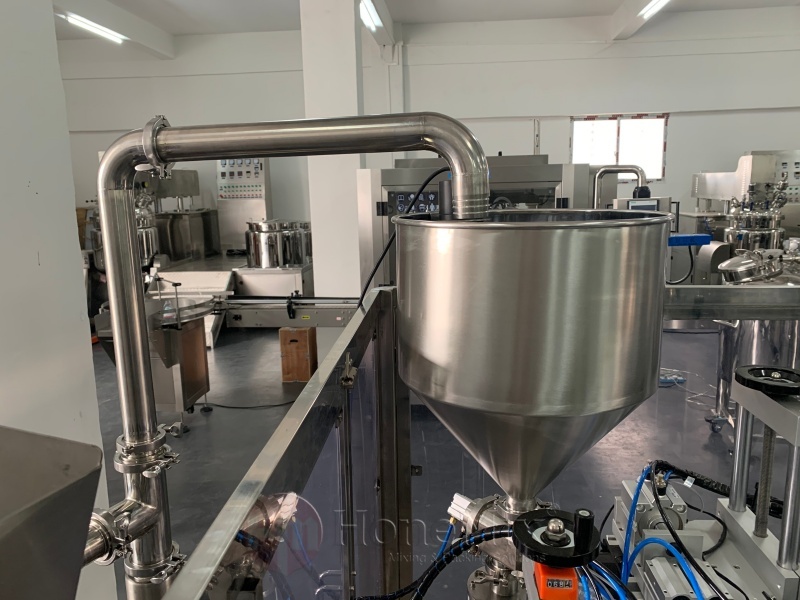
Vacuum mixing or deaeration can remove entrained air before packaging. Transfer piping should avoid unnecessary turbulence and suction leaks. The hopper should be filled in a controlled manner rather than allowing gel to fall from a height. If agitation is required to maintain uniformity, it should be slow enough to avoid creating a vortex.
Deliver the Gel to the Metering System Consistently
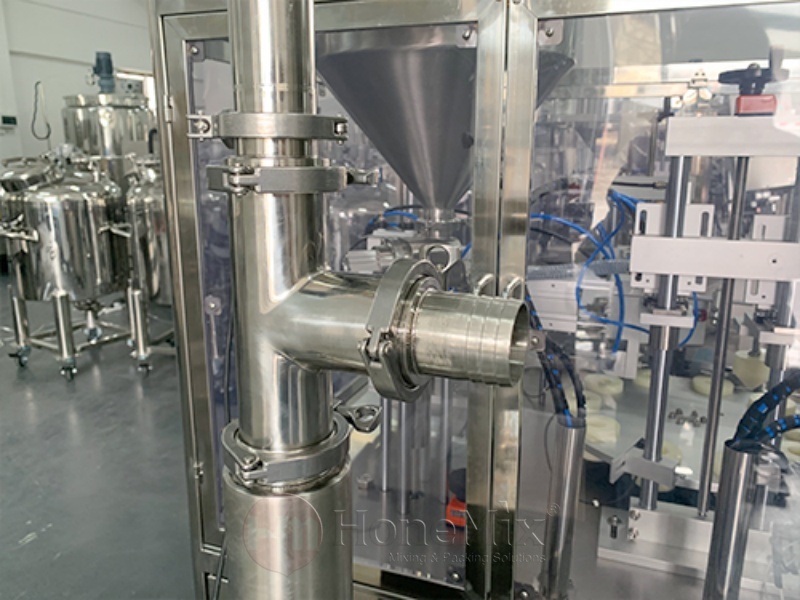
Even a precise piston or pump cannot meter reliably if the inlet conditions change. Product level, temperature, and feed pressure should remain within an established range. The transfer system must be sized for the gel rather than selected as though the product were water.
Control Temperature Across the Filling Run
Temperature can change gel viscosity and bubble behavior. A warm gel may flow faster and drip more easily, while a cooler gel may create higher pressure and slower cylinder refill. Production should define an acceptable filling temperature window and monitor it where variation is likely.
Avoid Starving or Overpressurizing the Filler
If the hopper level becomes too low, the metering system may draw air. If a transfer pump supplies excessive pressure, valves can leak or doses can vary. Level controls, appropriate pump selection, and coordinated replenishment help maintain a stable inlet condition. The line should stop or alarm before it begins producing visibly aerated or underfilled tubes.
Choose a Metering Method That Matches the Product
Piston filling is widely used for gels because it can handle a broad viscosity range and deliver repeatable volumes when the product supply is stable. Other pump types may be suitable for specific formulations, but the selection must consider shear, cleaning, particles, and the required volume range.
Verify Accuracy With Production Gel
Machine trials should use the actual cleanser or gel whenever possible. Water tests can confirm basic mechanical operation but do not reproduce refill time, stringing, valve response, or air behavior. The trial should cover the smallest and largest intended fill volumes and the expected viscosity range.
Net-weight checks remain useful even when the filler meters by volume. The team should tare empty tubes, measure individual filled units, and calculate variation. Density should be confirmed if it can change with aeration or temperature. Acceptance limits should reflect the declared content, internal quality standard, and applicable market requirements.
Set Refill and Discharge Speeds Separately
The cylinder or pump may need a slower suction stroke to avoid cavitation, while the discharge stroke may require a different profile to fill efficiently. A single speed setting is often a compromise. Where the control system allows, separate acceleration, filling, and cutoff parameters can improve repeatability and reduce mechanical shock.
Use the Nozzle to Control Air, Stringing and Tube Cleanliness
The nozzle is the final point of contact before the product enters the tube. Its internal diameter, outlet shape, shutoff design, filling depth, and withdrawal speed affect the appearance and accuracy of every dose.
Fill From the Bottom Up
Positioning the nozzle near the bottom of the empty tube and raising it as the product level increases helps reduce folding and air entrapment. The movement should be synchronized with the dose. If the nozzle rises too quickly, the gel can stretch into a thin strand. If it rises too slowly, pressure can build and product may smear the tube wall.
Create a Clean Cutoff
Stringing occurs when the gel remains connected between the nozzle and the filled tube after the dose ends. A positive shutoff valve, suck-back function, suitable outlet diameter, and controlled withdrawal can help. The best adjustment depends on gel elasticity and viscosity. Excessive suck-back may draw air into the nozzle, while insufficient cutoff leaves product on the tube wall.
Adapt the Process to Cleanser and Personal Care Gel Differences
Not all gels can use the same recipe. A surfactant facial cleanser may foam, while a carbomer gel may be clear and sensitive to bubbles. An exfoliating gel may contain particles that affect valves and nozzle size. An alcohol-based hand gel may require attention to volatility and facility safety.
Control Foaming in Facial Cleansers
Foam can be created by high-speed agitation, air leaks, free-fall transfer, rapid suction, or splashing inside the tube. Low-turbulence transfer and bottom-up filling are important. If the product contains surfactants, the line should avoid unnecessary recirculation and aggressive hopper mixing.
Foam may collapse after filling, leaving an apparently low tube or changing net content. Quality checks should therefore define when the sample is weighed and inspected. The process should eliminate foam rather than relying on a long waiting period to hide it.
Keep the Seal Area Free of Gel
Accurate dosing is not enough if gel reaches the tail seal. Product contamination can weaken the bond and create leakage. The selected fill volume should leave sufficient empty tube length, and the tube should move smoothly from filling to sealing without being squeezed.
Plastic and laminated tubes may use hot-air or ultrasonic sealing. Ultrasonic systems can provide compact, localized sealing for suitable materials, while hot-air systems depend on controlled heating and compression. Seal trials should evaluate strength, appearance, trimming, and coding under normal production speed.
Create an Accuracy and Quality Verification Plan
A practical plan begins with startup approval and continues through the batch. It should specify fill-weight frequency, visual inspection, bubble limits, seal checks, code verification, and actions for out-of-limit results. Samples should be taken after long stops, hopper refills, adjustments, and changeovers because these events can disturb the process.
Standardize Changeover Recipes
For multi-SKU factories, each gel and tube combination should have an approved setup covering holder size, nozzle, filling depth, metering parameters, cutoff, seal settings, trim position, and inspection criteria. Recipe control shortens changeover while preserving quality.
Select a Machine for the Complete Gel Packaging Task
The purchase decision should consider product rheology, bubble sensitivity, particles, fill range, tube material, tube dimensions, sealing method, coding, capacity, cleaning, and future formats. A supplier trial should include representative formulas and packaging components rather than generic test materials.
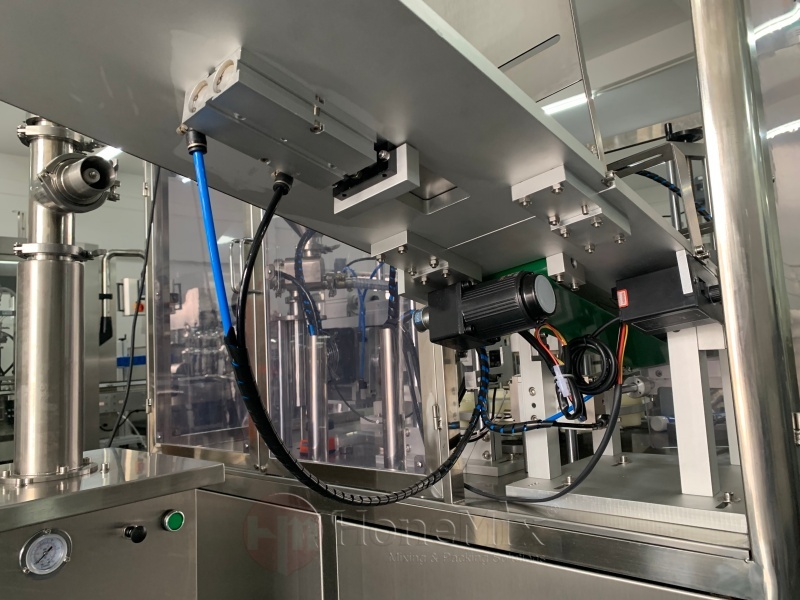
For plastic and laminated tube applications requiring filling, orientation, ultrasonic sealing, coding, trimming, and discharge, a properly configured Gel Tube Filling Machine can provide a controlled platform. The final configuration still needs to be confirmed against the actual cleanser or personal care gel, because formula behavior determines the correct pump, nozzle, speed, and cleaning method.
Achieving Accurate Gel Tubes in Daily Production
Accuracy comes from controlling the entire material and packaging path. A stable, deaerated gel must be transferred without turbulence, metered under repeatable conditions, filled through a suitable moving nozzle, kept away from the seal zone, and closed with a process matched to the tube. Continuous checks then confirm that performance remains stable throughout the batch.
HONEMIX provides mixing, vacuum processing, storage, transfer, filling, tube filling, sealing, and packaging equipment for cleanser, skincare, personal care, and related products. Manufacturers can provide their gel sample, viscosity information, tube specifications, filling volume, output target, and factory requirements so the equipment configuration can be assessed around actual production conditions.