Packaging flaws do not just compromise a single batch; they can trigger devastating product recalls. Product safety inherently depends on a perfect final seal. When dealing with highly viscous pharmaceutical creams, gels, and ointments, standard packaging methods often fail miserably. Thick formulations cause dosing errors, air pockets, and messy leaks. This not only risks severe contamination but virtually guarantees failure during strict Good Manufacturing Practice (GMP) compliance audits.
To overcome these costly bottlenecks, forward-thinking production managers are turning to specialized automation. Upgrading to the right equipment ensures regulatory compliance, maximizes output, and guarantees the impenetrable seals required for sensitive medical products. In this comprehensive technical guide, you will learn exactly how these advanced systems solve complex packaging challenges and what specific engineering criteria to evaluate before making your next machinery investment.
Key Takeaways
Precision and Compliance: Pharmaceutical packaging demands strict adherence to GMP standards. This requires sanitary 316L stainless steel (with a surface roughness of Ra < 0.4µm) for all product contact parts, alongside integrated Clean-in-Place (CIP) capabilities.
Specialized Sealing: Unlike plastic alternatives, metal tubes demand distinct mechanical folding techniques. Precise double, triple, or saddle folds are absolutely necessary to achieve a completely leak-proof and airtight barrier.
Automation is Key: Implementing servo-driven equipment drastically reduces reliance on manual cleanroom labor, eliminates costly product giveaway, and accelerates production speeds up to 120 tubes per minute.
Scalability: Selecting the proper machinery involves a calculated analysis of your facility's batch sizes, specific fluid rheology (viscosity levels), and required daily throughput.
The Resurgence of Metal: Industry Trends in Pharma Packaging
Before diving into the machinery, it is crucial to understand the market forces driving equipment upgrades. Recent industry analyses reveal a massive surge in demand for specialized dermatological treatments. As the global population ages, the requirement for prescription skincare and topical ointments is skyrocketing.
Concurrently, there is a distinct industry shift toward highly protective, infinitely recyclable packaging. Aluminum is making a major comeback, replacing laminated plastics in many premium and prescription lines. It completely blocks ultraviolet light, moisture, and oxygen from degrading active pharmaceutical ingredients (APIs). Furthermore, metal does not exhibit "suck-back"—the tendency to draw contaminated air back into the nozzle after squeezing. Therefore, upgrading your packaging line is no longer just a capacity play; it is a strategic necessity to meet both stringent regulatory scrutiny and shifting consumer sustainability preferences.
What is an Automatic Tube Filling Machine for Aluminum Tubes?
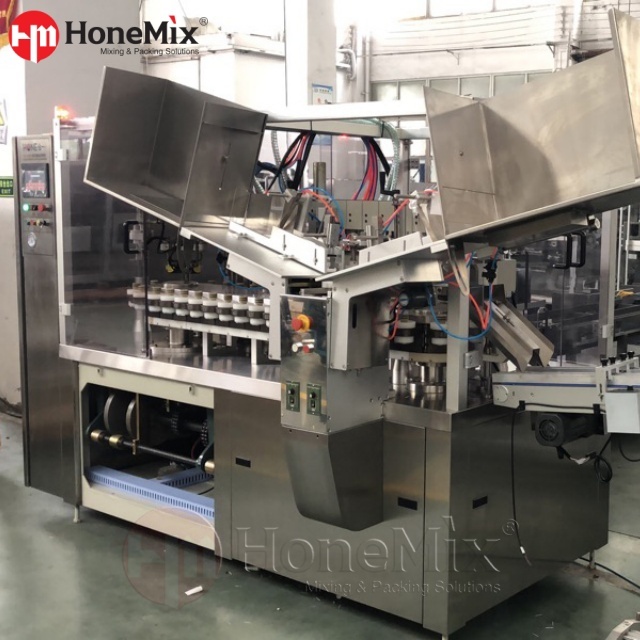
At its core, this machinery is a highly synchronized industrial packaging system engineered to streamline the final, critical stages of product manufacturing. Its primary function is to automatically load empty containers into a rotary index table, dispense a highly precise volume of semi-solid product, and mechanically seal the end. By taking human handling out of the equation, facilities maintain rigorous quality control while dramatically increasing their daily output.
How the Machinery Differs from Plastic Fillers
The packaging equipment required for metal operates on entirely different thermodynamic and mechanical principles than machinery designed for plastic variants. While plastic requires hot air nozzles or ultrasonic friction to melt and fuse the ends together, an Aluminum Tube Filling Machine relies on cold mechanical crimping. The system uses heavy-duty, specialized metal jaws to physically manipulate and fold the end multiple times, creating a secure mechanical lock without applying heat that could degrade sensitive APIs.
Standard liquid fillers that rely on gravity or basic overflow mechanisms are woefully inadequate for processing pharmaceutical creams. Semi-solid products possess unique rheological properties. They are thick, sticky, and resist natural flow, demanding specialized handling to maintain product integrity.
GMP Compliance and Sanitary Design
Pharmaceutical manufacturing is governed by strict regulatory frameworks. Consequently, a dedicated Ointment Tube Filling Machine must be constructed to meet these rigorous hygiene standards. Superior machines utilize 316L stainless steel for all dosing cylinders, hoppers, and nozzles. This alloy offers exceptional resistance to corrosion caused by aggressive chemical ingredients and sterilization agents. Smooth, crevice-free welding (often utilizing tri-clamp connections) prevents cross-contamination between different product batches.
Mastering High Viscosity Products
Pushing dense, sticky creams through a standard nozzle often creates air pockets, leading to inaccurate fill weights. To counter this, specialized equipment utilizes robust, servo-driven rotary valve piston pumps. These pumps provide the necessary pneumatic force to shear and move dense materials. In practical terms, feeding hoppers (typically 40L to 50L in capacity) are frequently equipped with slow-moving agitation stirrers and water-jacketed heating systems. Gently heating the hopper to around 40°C–50°C reduces the ointment's viscosity just enough to let it flow smoothly into the dosing cylinder without introducing microscopic air bubbles.
Step-by-Step: How the Filling and Sealing Process Works
Understanding the operational workflow highlights exactly how these systems achieve such high efficiency. The entire process is a synchronized ballet of automated steps managed by a central Programmable Logic Controller (PLC).
Step 1: Automatic Loading: A pneumatic mechanical arm or vacuum chute swiftly plucks empty tubes from a bulk cassette, feeding them one by one into the holding pucks of the rotary index table.
Step 2: Orientation & Cleaning: High-speed photoelectric sensors read the registration mark on the exterior, rotating the tube via stepper motors so the printed brand graphics face the perfect direction. A quick burst of compressed air (0.4-0.6 MPa) sweeps the interior, removing any microscopic dust.
Step 3: Precision Filling: The dosing nozzle descends all the way to the bottom of the empty container. As the thick product is dispensed, the nozzle slowly rises. This critical "bottom-up" filling technique actively pushes out trapped air, ensuring a dense, accurate dose.
Step 4: Mechanical Folding: A series of heavy-duty mechanical jaws crimp and fold the open metal end. This station operates sequentially, folding the metal two to four times to create an impenetrable barrier.
Step 5: Batch Coding & Ejection: Finally, hardened steel characters stamp the expiration date and lot number directly into the folded metal crimp. The finished product is automatically ejected onto a conveyor, ready for cartoning.
Understanding Metal Folding Techniques
The sealing mechanism is the defining mechanical component of this machinery. The complexity of the fold directly correlates with the security of the medication inside.
The Double Fold
This is the most basic mechanical seal. The machine flattens the end, folds it over once, and then folds it over a second time before applying high pressure to crimp it flat. It is highly efficient and generally utilized for smaller sizes containing basic cosmetics or low-risk topical ointments.
The Triple Fold
For over-the-counter (OTC) pharmaceutical creams, the triple fold is the industry standard. Following the initial flattening, the metal is folded over three distinct times. This additional layer creates a significantly more robust barrier against moisture ingress and ensures the seam does not burst when squeezed forcefully by the consumer.
The Saddle Fold (Four-Fold)
Providing the highest level of security available, the saddle fold interlocks the metal in a way that resembles a riding saddle. This leak-proof seal is mandatory for highly sensitive prescription ointments, sterile eye creams, and products containing volatile active ingredients. Premium machines feature modular folding stations, allowing engineers to easily switch between these styles based on the specific production run.
Top Benefits of Upgrading Your Packaging Line
Transitioning from manual or semi-automatic processes to a fully automated system requires capital investment, but the operational returns are substantial and immediate.
Unmatched Dosing Accuracy
Product giveaway—filling a container with slightly more product to avoid under-filling penalties—is a massive hidden cost. Modern automated machines utilize servo-driven piston pumps that control the dispensing volume with an accuracy of ±1%. This extreme precision eliminates costly waste, which is particularly vital when handling expensive APIs.
Reduced Labor and Human Error
In cleanroom environments, human operators are the primary source of biological contamination. Automation drastically reduces the number of personnel required on the packaging floor. By removing manual handling from the loading and sealing stages, facilities minimize the risk of human error and easily maintain ISO-certified sanitary conditions.
Choosing the Right Machinery: A Technical Selection Guide
Selecting the appropriate machinery requires a calculated alignment between your facility's current demands and projected future growth. Over-capitalizing reduces ROI, while under-specifying leads to immediate bottlenecks. Below is a practical breakdown to guide your investment.
Global pharmaceutical enterprises, high-volume continuous production.
Changeover Time
< 30 minutes (Tool-less SMED design)
< 45 minutes
For Medium-Scale Production Facilities
Medium-scale operations require equipment that balances consistent output with high versatility. For these environments, investing in a robust, single-head Automatic Tube Filler and Sealer (such as the HY-A600 series) is highly recommended. These models typically operate on an intermittent rotary indexing mechanism, delivering a reliable output of up to 60 units per minute. They offer a compact footprint suitable for tight cleanrooms and provide the necessary PLC automation to ensure GMP compliance without a massive capital expenditure.
For High-Speed, Large-Scale Pharma Production
When product demand necessitates manufacturing millions of units annually, standard single-head indexers simply cannot keep pace. Facilities must deploy high-capacity systems, such as a dual-head Aluminum Tube Filling Machine (like the HY-A800 series). By utilizing twin dosing nozzles and dual mechanical folding stations, these machines process two units simultaneously during each cycle. This configuration effectively doubles production output, routinely achieving speeds of 80 to 120 units per minute.
Conclusion
Choosing the correct equipment is the foundational step to ensuring strict regulatory compliance and protecting your brand's reputation. Proper packaging maintains product safety, prevents contamination, and significantly extends shelf life. Whether you are packaging a thick medical ointment or a specialized dermatological cream, an automated system optimizes your entire workflow, turning a potential bottleneck into a highly profitable operation.
Ready to upgrade your production line? Assess your specific production volume and viscosity challenges, consult with engineering experts to finalize your facility layout, and explore tailored, GMP-compliant solutions from Hone Machine to future-proof your manufacturing capabilities.
FAQ
Can the same automatic tube filling machine handle both aluminum and plastic tubes?
From a mechanical engineering perspective, the dosing and filling mechanisms operate identically regardless of the material. However, the sealing mechanisms are fundamentally different. Plastic requires thermal sealing (hot air or ultrasonic friction), whereas metal requires cold mechanical crimping. While some hybrid machines exist with interchangeable sealing heads, transitioning between the two is labor-intensive. For pharmaceutical facilities operating under strict GMP guidelines, utilizing dedicated machines for specific materials is highly recommended to ensure validation consistency.
What is the maximum viscosity an ointment tube filling machine can handle?
The capability to handle highly viscous substances depends entirely on the feeding system. Standard gravity-fed hoppers are insufficient for thick pastes. Advanced machines utilize positive displacement rotary piston pumps capable of accurately dosing products with viscosities exceeding 100,000 centipoise (cP). To facilitate flow, these systems are often equipped with water-jacketed hoppers that safely apply controlled heat, temporarily lowering the viscosity during the filling process.
How long does it take to change over the machine for a different tube size?
Historically, changing formats required extensive manual recalibration. However, contemporary automated systems are designed with operational efficiency in mind. By utilizing quick-release mechanisms, modular holding pucks, and touchscreen-driven recipe recall, a trained operator can execute a complete format changeover in approximately 15 to 30 minutes. This rapid turnaround is essential for facilities processing multiple product variations in a single shift.
Do these machines come with batch coding capabilities?
Yes, batch coding is a regulatory-mandated component of pharmaceutical packaging. Unlike plastic, which uses inkjet or thermal transfer printing, metal utilizes mechanical embossing. During the final stage of the folding process, hardened steel coding characters are pressed directly into the metal crimp. This physically stamps the expiration date and lot number into the seal, making it permanent, tamper-proof, and immune to smudging from chemical spills.
What is the standard filling accuracy for pharmaceutical creams?
For GMP-compliant pharmaceutical manufacturing, precision is non-negotiable. High-quality automated tube fillers utilizing servo-driven piston pumps typically achieve a filling accuracy of ±1% or better. This tight tolerance ensures that every single tube meets the exact dosage requirements stated on the label, eliminating costly product giveaway and preventing regulatory fines for under-filling.
How often should maintenance be performed on the mechanical folding jaws?
Because the mechanical jaws exert significant physical force to crimp aluminum, they are subject to wear over time. It is generally recommended to perform a visual inspection and light lubrication of the pneumatic linkages weekly. A comprehensive calibration check of the folding tolerance should be conducted monthly or every 500,000 cycles, depending on the thickness of the metal tubes being processed, to ensure the saddle or triple folds remain completely airtight.