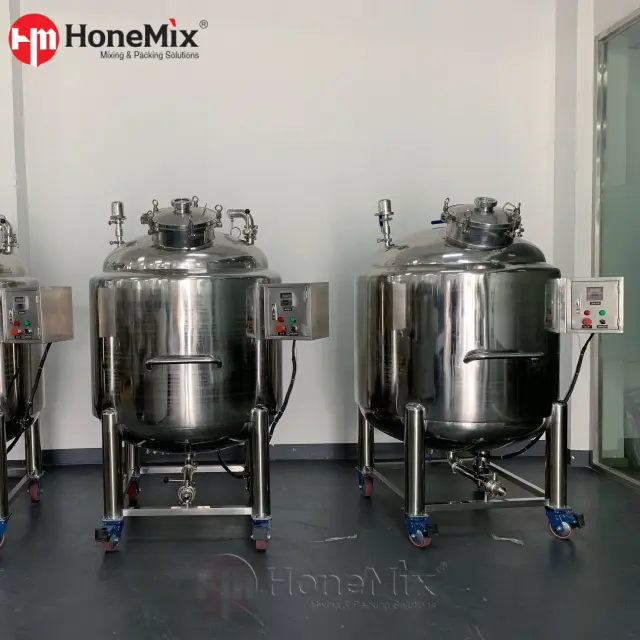
Inconsistent viscosity, micro-aeration, and phase separation in personal care manufacturing directly erode brand trust and increase batch rejection rates. Scaling the production of hand washes and shower gels requires precise control over shear rates and temperature. Standard agitation is insufficient for complex surfactant blends, leading to bottlenecks in processing times, product instability, and costly setup mistakes. Selecting the correct Liquid Soap Mixing Tank is a strict rheological requirement. This guide breaks down the technical specifications, agitation configurations, thermal control systems, and compliance documentation necessary to evaluate and procure equipment that guarantees batch-to-batch consistency and regulatory compliance.
Key Takeaways
Agitation is Formulation-Dependent: High-viscosity shower gels require dual-way agitation and Teflon wall scrapers, while standard hand washes may only need bottom-entry homogenizers.
Thermal Management Dictates Cycle Times: Integrating an electric heating mixing storage tank accelerates the dissolution of solid surfactants and pearlizing agents, reducing overall batch time.
Material Compliance is Non-Negotiable: 316L stainless steel contact parts are mandatory to prevent corrosion from high-chloride surfactants and maintain GMP compliance.
Facility Agility: For multi-product facilities, R&D, or pilot runs, a mobile stainless steel mixing tank offers necessary flexibility without requiring fixed hard-piping infrastructure.
Automation Ensures Traceability: Upgrading to PLC/HMI control systems eliminates human error in recipe execution and provides essential data logging for quality assurance.
Success Criteria for High-Viscosity Personal Care Products
Overcoming Phase Separation and Aeration
Formulating liquid soaps involves blending water, surfactants, thickeners, and preservatives. These elements naturally resist uniform integration. High-foaming surfactants entrap air easily during mechanical agitation. Micro-aeration creates cloudy gels and reduces the specific gravity of the final product. This leads to inaccurate fill weights on the packaging line and unacceptable visual defects in clear packaging.
You must define the mechanical requirements to prevent air entrapment. Vacuum mixing capabilities pull negative pressure on the vessel, typically between -0.06 and -0.09 MPa. This forces entrapped air bubbles to expand, rise, and burst at the surface. Vacuum integration is mandatory for clear shower gels and high-viscosity hand washes. Without it, you will spend hours waiting for batches to naturally de-aerate in holding tanks.
Establishing acceptable shear rates ensures stable emulsions. High shear is necessary to hydrate powder thickeners like carbomers or cellulosic gums. However, sustained high shear breaks delicate polymer chains. This causes irreversible shear-thinning, ruining the batch. You need variable speed control to apply high shear during powder induction and low shear during the final blending phase. Operators must monitor the vortex closely; a deep vortex pulls ambient air directly into the impeller zone.
Achieving Consistent Rheology
Rheology determines how a product flows and rests. Shower gels require a high yield stress to suspend exfoliating beads or air bubbles. Liquid hand soaps require lower yield stress for easy pumping through standard dispensers. You must map the relationship between mixing speed, temperature, and final viscosity using a Brookfield viscometer during the pilot phase.
Temperature directly impacts surfactant solubility and polymer hydration. Cold mixing extends hydration times and leaves unhydrated fish-eyes in the batch. Controlled heating reduces fluid viscosity during mixing. This allows agitators to move the bulk fluid efficiently without overloading the motors. Success metrics for batch uniformity include consistent yield stress, predictable pourability, and absolute visual clarity for transparent formulations. You must establish strict temperature setpoints for each phase addition to prevent thermal shock to sensitive ingredients.
Core Components of an Industrial Liquid Soap Mixing Tank
Agitation Systems: Homogenizers vs. Scraper Blades
Standard propellers fail in high-viscosity applications. They create localized flow near the shaft while the product at the tank walls remains stagnant. Complex formulations require multi-component agitation systems engineered for specific fluid dynamics.
Bottom-Entry Homogenizers: These units utilize a rotor-stator mechanism with a tight tolerance gap, often between 0.5mm and 1.5mm. They draw solids and liquids into this gap, generating intense mechanical and hydraulic shear. Bottom-entry placement is ideal for rapid dispersion of heavy powders like salt and Carbopol before they float on the surface.
Top-Entry Homogenizers: Useful for specific emulsion types, but they risk drawing air into the batch via the vortex if not properly baffled. They require longer shafts, which can introduce vibration issues at high speeds.
Anchor Agitators: These large, frame-like impellers sweep the entire inner diameter of the vessel. They promote bulk flow in highly viscous gels, moving product from the walls toward the center homogenizer.
Teflon Scraper Blades: Hinged scrapers attach to the anchor agitator. They physically scrape the tank walls during rotation. This prevents localized overheating, stops product burn-on, and ensures uniform heat transfer across the jacketed surface.
Counter-Rotating Blades: In highly complex tanks, a central pitched-blade turbine rotates in the opposite direction of the outer anchor. This creates aggressive chaotic flow, slashing mixing times for non-Newtonian fluids.
Thermal Control: Heating and Cooling Integration
Thermal management dictates batch cycle times. Solid surfactants, waxes, and pearlizing agents require heat for proper dissolution. Integrating an electric heating mixing storage tank provides independent thermal control for facilities lacking a central steam boiler. This eliminates the need for expensive facility upgrades just to run heated batches.
These tanks utilize a heating jacket filled with water or thermal oil. Electric elements heat the medium, which transfers thermal energy across the tank wall. Thermal oil retains heat longer and achieves higher temperatures without pressurization, while water is cheaper and easier to maintain. This method offers precise, programmable temperature ramps. Steam heating is faster but requires extensive facility infrastructure, pressure vessel certifications, and continuous boiler maintenance.
Cooling is equally critical. Preservatives and volatile fragrances degrade if added at high temperatures. Jacketed tanks must support chilled water circulation. Rapid cooling stabilizes pearlizing agents, ensuring a consistent, shimmering appearance in the final shower gel. You must size your facility's chiller to handle the sudden thermal load when transitioning from the heating phase to the cooling phase.
Material Standards and Surface Finish
Personal care formulations often contain aggressive chlorides, sulfates, and varying pH levels. Material selection directly impacts equipment lifespan and product safety. Using substandard alloys leads to rapid equipment failure and contaminated products.
Product contact parts must utilize 316L stainless steel. The "L" denotes low carbon, which prevents carbide precipitation during welding. 316L contains molybdenum. This element provides superior resistance to pitting and crevice corrosion caused by salts. Non-contact parts, such as external cladding and structural frames, can utilize 304 stainless steel to optimize resource allocation without compromising sanitary standards.
Internal surface finish prevents bacterial harborage. Mechanical polishing must achieve a roughness average (Ra) of 0.4 µm or better. Many facilities opt for electropolishing, which removes microscopic peaks and valleys, leaving a mirror-like finish. Smooth surfaces facilitate efficient cleaning, prevent biofilm buildup, and eliminate cross-contamination between different color or fragrance runs.
Automation and Batch Control Systems
Manual operation introduces human error. Operators may misread temperatures, miscalculate mixing durations, or open the wrong valve. Upgrading to Programmable Logic Controllers (PLCs) and Human-Machine Interfaces (HMIs) standardizes the manufacturing process and locks in batch consistency.
PLCs store multi-phase mixing recipes. They automate temperature ramps, agitator speeds, and vacuum cycles using precise PID loops. HMIs provide visual feedback to operators, displaying real-time tank levels, temperatures, and motor loads. Automated data logging records temperature, RPM, and duration for every batch. This data is essential for GMP compliance, quality assurance, and root-cause analysis during batch investigations. Systems compliant with 21 CFR Part 11 ensure electronic signatures and audit trails are securely maintained.
Evaluating Tank Configurations for Your Facility
Fixed vs. Mobile Stainless Steel Mixing Tank Systems
Facility layout and product diversity dictate tank configuration. Large-scale, single-product operations benefit from fixed installations. Multi-product, agile facilities require modular solutions that can adapt to changing production schedules.
Fixed liquid mixing tank installations range from 1,000L to 5,000L or more. They require dedicated footprint, hard-piped utilities, and integrated transfer pumps. These systems maximize throughput for high-volume SKUs. They often sit on load cells for automated ingredient dosing and require structural mezzanines for operator access to the top manway.
Conversely, deploying a mobile stainless steel mixing tank (typically 100L to 500L) offers distinct operational flexibility. You can utilize these units for pilot batches, R&D testing, or agile contract manufacturing. Operators can move the tank directly to the filling line, eliminating the need for complex transfer piping. They utilize heavy-duty caster wheels and quick-disconnect utility fittings.
Feature
Fixed Mixing Tanks (1000L+)
Mobile Mixing Tanks (100L - 500L)
Primary Application
High-volume, continuous production
R&D, pilot runs, custom color/fragrance
Utility Requirements
Hard-piped steam, water, and power
Quick-disconnect utilities, standard plugs
Footprint
Large, permanent installation
Small, easily relocated via casters
Cleaning
Automated CIP systems required
Manual or semi-automated CIP
Transfer Method
Hard-piped positive displacement pumps
Direct discharge to hopper or portable pump
Capacity Scaling and Batch Cycle Times
Selecting the correct tank volume prevents operational bottlenecks. Total tank capacity differs from working volume. The optimal working volume is typically 70-80% of the total capacity. This headspace prevents overflow during surfactant expansion and accommodates the vortex generated during high-speed homogenization. Overfilling a tank compromises the vacuum system by pulling liquid into the vacuum pump.
Scaling from lab-size to production-size tanks requires careful engineering. Motor horsepower, impeller diameter, and tip speed must scale proportionally to maintain geometric similarity. Failing to maintain identical mixing dynamics results in scale-up failures. A formulation that succeeds in a 50L pilot tank may separate in a 2,000L production tank if shear rates and power per unit volume (P/V) are mismatched.
Downstream Integration and Transfer
Transferring high-viscosity gels out of the mixing tank requires specific pump technologies. Centrifugal pumps operate at high speeds and induce severe shear. This destroys the viscosity of finished shower gels, turning a thick gel into a watery liquid before it reaches the bottle.
You must determine compatibility with positive displacement pumps. Lobe pumps and progressive cavity pumps move viscous fluids gently. They rely on volumetric displacement rather than kinetic energy. Evaluate discharge valve sizing and placement. Bottom-center discharge valves ensure complete drainage. Sanitary tri-clamp connections ensure seamless integration with automated liquid filling lines and prevent dead legs in the piping network.
CIP/SIP (Clean/Sterilize-in-Place) Capabilities
Frequent changeovers demand efficient cleaning protocols. Manual cleaning is labor-intensive, requires confined space entry permits, and introduces contamination risks. Integrated CIP systems automate the cleaning process, ensuring repeatable sanitation.
Spray Balls: Strategically placed rotary or static spray balls ensure 360-degree coverage of the internal tank surfaces. They require specific flow rates (e.g., 1.5 m/s velocity) to generate enough mechanical impingement to remove sticky gels.
Self-Draining Bottoms: Conical or dished tank bottoms facilitate complete fluid evacuation, leaving no residual product or rinse water behind.
Sanitary Valves: Flush-mounted diaphragm valves eliminate dead legs where bacteria can harbor. Standard ball valves are unacceptable in sanitary applications due to internal cavities.
Validation: CIP protocols must specify flow rates, temperatures, and chemical concentrations. You must perform riboflavin wash tests during commissioning to guarantee complete coverage.
Operational Efficiency and Conceptual Trade-Offs
Energy Consumption vs. Production Speed
Equipment selection involves balancing energy draw against production velocity. High-shear homogenizers and electric heating elements require significant electrical capacity. You must evaluate the operational trade-off between high energy consumption and the reduction in batch processing time.
Rapid heating accelerates surfactant dissolution. This cuts batch times significantly, allowing more batches per shift. However, running heating elements at maximum capacity spikes electrical demand. Implementing Variable Frequency Drives (VFDs) for agitation control optimizes energy use. VFDs allow motors to draw only the power necessary for the current fluid viscosity, rather than running at full speed constantly. Proper jacket insulation (e.g., 50mm polyurethane foam) prevents heat loss and reduces the continuous load on heating elements.
Customization vs. Standard Off-the-Shelf Configurations
Standard mixing tanks deploy quickly and require fewer engineering resources upfront. They suit basic formulations like thin liquid hand washes. However, highly viscous or complex shower gels often require custom geometries and specialized agitation.
Assess the implementation speed of standard models against the potential operational friction of retrofitting later. Adding load cells for precise ingredient weighing, integrating vacuum pumps for de-aeration, or installing automated dosing systems post-installation causes significant downtime. Specifying these requirements during the initial design phase ensures a cohesive, highly efficient system. Adding spare sanitary ports to the tank lid during fabrication provides cheap insurance for future process modifications.
Vendor Support and Compliance Documentation
Regulatory compliance requires rigorous documentation. Equipment vendors must provide comprehensive validation packages. This includes Installation Qualification (IQ), Operational Qualification (OQ), and Performance Qualification (PQ) protocols. Without these, validating the equipment for GMP production becomes a massive internal engineering burden.
Material test reports (MTRs), specifically EN 10204 3.1 certificates, verify the exact composition of the stainless steel used in your tank. Weigh the upfront effort of securing this documentation against the long-term value of accelerated regulatory audits. Evaluate vendor aftermarket support. Ensure rapid availability of critical spare parts, such as mechanical seals, stator heads, and Teflon scrapers, to minimize unplanned downtime.
Implementation Risks and Mitigation Strategies
Utility Requirements and Facility Footprint
Deploying heavy machinery introduces infrastructure risks. Inadequate electrical infrastructure will fail to support high-draw heating elements and homogenizer motors simultaneously. This leads to tripped breakers, stalled production, and ruined batches.
Conduct a thorough utility audit prior to procurement. Verify your facility's voltage, phase, and amperage limits. If electrical capacity is capped, consider phased heating strategies. Heat the water phase before engaging heavy agitation. Alternatively, utilize thermal oil jackets which hold heat longer and reduce continuous electrical draw. Ensure your compressed air system can handle the pneumatic demands of automated sanitary valves.
Avoiding Common Setup Mistakes
Incorrect sensor placement ruins batches. If an RTD temperature probe sits in a dead zone behind a baffle, it provides false readings. The PLC will continue heating, scorching the product on the tank walls. Ensure RTD probes extend directly into active mixing zones.
Mismatched shear rates cause irreversible product thinning. Applying high shear to a fully hydrated carbomer gel breaks the polymer network. Utilize VFDs to fine-tune shear rates during the commissioning phase. Establish strict RPM limits for each phase of the formulation. Ensure baffles are correctly sized to prevent deep vortexing, which pulls air into the batch even without a vacuum system engaged.
Operator Training and Maintenance Protocols
Equipment durability relies on operator competence. Premature wear of mechanical seals occurs when operators run homogenizers dry. Mechanical seals require fluid lubrication and cooling. Dry-running shatters the seal faces instantly, leading to catastrophic leaks and expensive repairs.
Implement strict Standard Operating Procedures (SOPs). Mandate mechanical seal lubrication checks before starting any motor. Schedule routine inspections of Teflon scrapers. Worn scrapers fail to clear product from the heated walls, leading to burn-on and degraded heat transfer efficiency. Train operators to monitor motor amperage on the HMI; sudden spikes indicate abnormal fluid viscosity or mechanical binding.
Conclusion
Audit your facility's electrical and chilled water capacities to determine the maximum allowable heating and cooling loads before selecting a tank size.
Compile a rheology profile of your most viscous formulations to specify the required homogenizer motor horsepower and scraper torque.
Request a documented Factory Acceptance Test (FAT) that includes a riboflavin wash test to verify CIP spray ball coverage prior to shipment.
Standardize your transfer piping with sanitary tri-clamps and positive displacement pumps to prevent shear-thinning during product discharge.
FAQ
Q: What is the ideal RPM for mixing liquid soap and shower gel?
A: Anchor agitators run at 10-60 RPM to promote bulk flow and prevent aeration. Homogenizers operate at 2800-3000 RPM to generate the extreme shear necessary for rapid powder dispersion and emulsification. You must use variable frequency drives to adjust these speeds based on the specific phase of your formulation.
Q: Why is 316L stainless steel required for a liquid mixing tank?
A: 316L stainless steel contains molybdenum. This addition provides superior resistance to pitting and crevice corrosion. Personal care formulations utilize aggressive salts, chlorides, and surfactants that rapidly degrade standard 304 stainless steel. Using 316L for all product contact parts ensures equipment longevity and prevents heavy metal contamination in your batches.
Q: Can an electric heating mixing storage tank also cool the product?
A: Yes. Jacketed tanks circulate chilled water through the jacket after the electric heating cycle completes. Rapid cooling is mandatory for bringing the batch down to a safe temperature before adding volatile fragrances and heat-sensitive preservatives. You must size your facility's chiller to handle the thermal load of the jacket.
Q: How do I prevent foam buildup during the mixing process?
A: Utilize vacuum mixing technology to pull entrapped air out of the batch. Employ bottom-entry agitation to prevent surface vortexing. Use variable frequency drives to maintain low shear rates during the final blending of high-foaming surfactants. Keeping the agitator blades fully submerged before increasing RPM also prevents mechanical air entrainment.
Q: When should a facility utilize a mobile stainless steel mixing tank?
A: Mobile tanks are ideal for R&D, pilot scaling, and small custom batches. They allow operators to transport pre-mixed phases directly to a larger primary mixing vessel or filling line. This eliminates the need for complex, permanent hard-piping and reduces product loss during transfer.