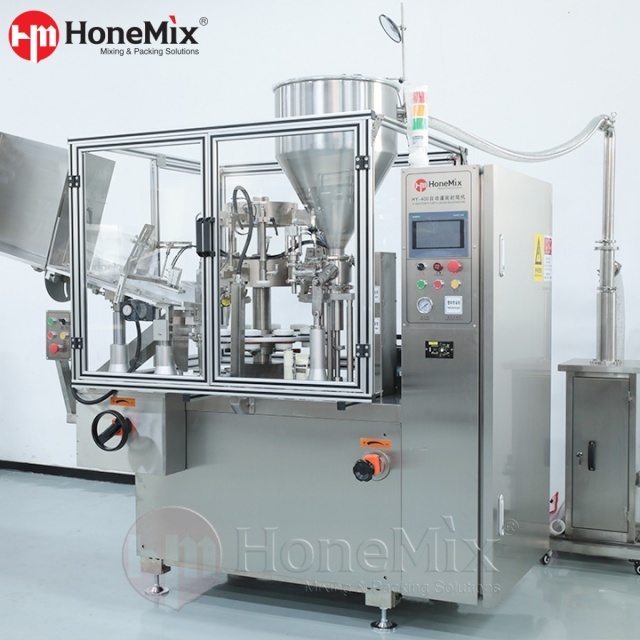
I have seen perfectly good toothpaste formulations ruined before they even hit the shipping dock. Why? Poor packaging execution. Toothpaste isn't just minty water. It is a dense, highly viscous suspension of abrasives, humectants, and active ingredients like fluoride. If you expose it to air or use the wrong barrier material, it degrades fast.
To preserve these active ingredients, high-viscosity pastes demand highly specialized laminated tubes. But filling these advanced materials is not as simple as dropping product into a funnel. It requires precise, automated packaging equipment engineered to handle thick rheology without introducing microscopic air pockets. In this guide, we are going to look at the process from a frontline engineering perspective. We will break down the mechanical intricacies of automated systems, dive into material sciences, and give you actionable standards for choosing the right production equipment to scale your factory floor.
Key Takeaways
Laminates are Non-Negotiable: Standard plastics fail in oral care. ABL (Aluminum Barrier Laminate) and PBL (Plastic Barrier Laminate) provide the structural integrity needed to protect sensitive formulations.
Automation Equals Scalability: Moving to an automated line drastically boosts output and ensures strict GMP (Good Manufacturing Practice) compliance by minimizing human contact.
Thermal Dynamics Matter: Getting the thermal sealing right guarantees a leak-proof, consumer-ready tube tail that survives rough transit.
System Handshakes: A filler does not work alone. It must integrate seamlessly with upstream vacuum mixers and downstream cartoners to prevent bottlenecks.
The State of Oral Care Packaging: A Shift in the Market
Before we touch the machinery, we need to look at what is happening in the broader market. Over the last few years, the personal care sector has experienced a massive shift toward sustainable packaging. Regulatory pressures and consumer demands are forcing brands to rethink their primary packaging.
Historically, aluminum tubes or heavy aluminum-core laminates dominated the toothpaste aisle. Today, we are seeing an aggressive transition toward advanced plastic laminates (like EVOH barriers) that meet strict recyclability mandates. However, you cannot just swap tube materials and expect your old filling machine to run perfectly. Different laminates have different thermal melting points and structural memory. Understanding these material properties is the very first step in optimizing your filling line.
Why Laminated Tubes are the Standard
For production managers and packaging engineers, the physical properties of the tube dictate the machine's setup. Toothpaste is highly sensitive to environmental factors. Oxygen ingress chemically alters fluoride, killing its anti-cavity efficacy. Moisture loss dries out humectants, turning a smooth paste into a solid block. Furthermore, aggressive flavoring agents like peppermint oil will migrate right through standard mono-layer plastics, a phenomenon known as "flavor scalping."
Laminated tubes solve this by using multiple microscopic layers to build a fortress around the product.
ABL vs. PBL Tubes: The Engineering Breakdown
The industry relies on two specific types of laminates. Their physical characteristics directly impact how we tune the heating and sealing stations on a Laminated Tube Filling Machine.
ABL (Aluminum Barrier Laminate): This features a microscopic aluminum foil core sandwiched between polyethylene (PE) layers. The metal acts as an absolute barrier to light, moisture, and oxygen. ABL has excellent "dead-fold" memory—when you squeeze it, it stays squeezed.
PBL (Plastic Barrier Laminate): This replaces the metal core with a highly specialized plastic barrier, usually EVOH (Ethylene Vinyl Alcohol). PBL tubes bounce back to their original shape after squeezing. Because they lack metal, they align with modern 100% recyclability goals.
Here is a quick reference guide for how these materials stack up on the production floor:
Material Type
Barrier Core
Structural Memory (Squeeze)
Recyclability
Best Application
ABL
Aluminum Foil
Dead-fold (holds shape)
Low (Mixed materials)
Traditional toothpaste, highly sensitive OTC pharma
Transitioning to automated systems requires understanding machine kinematics. Toothpaste is a non-Newtonian fluid. It boasts an exceptionally high viscosity, usually sitting between 70,000 and 100,000 centipoise (cP). You cannot just rely on gravity to move this dense material.
To overcome this stubborn rheology, industrial equipment utilizes robust positive displacement piston pumps. Unlike gentle peristaltic pumps used for watery liquids, a rotary valve piston pump mechanically draws a precise volume of paste into a steel cylinder, then forcefully extrudes it.
On the factory floor, we often equip the machine's hopper with specific mechanical enhancements to keep the paste flowing smoothly:
Jacketed Heating: We use double-walled hoppers heated with circulating water. Warming the paste slightly reduces its viscosity, improving flow without degrading the active fluoride.
Agitators: Slow-speed scraping paddles rotate inside the hopper. This prevents the heavy paste from channeling or forming air pockets before it hits the dosing pump.
Pressurization: For ultra-thick formulations, we seal the hopper and inject sterile compressed air, physically forcing the heavy product down into the cylinder.
Step-by-Step: The Automated Filling and Sealing Process
When I set up a new line, I look closely at the rotary indexing table. Driven by a high-torque servo motor or Geneva mechanism, this table moves custom-machined "pucks" (tube holders) through specialized workstations. Let's walk through the actual cycle.
Eye-Mark Orientation
First, an empty tube drops into the puck. Because laminated tubes are pre-printed, they must be perfectly aligned. If they aren't, your brand logo will look crooked on the retail shelf. We achieve this using high-speed photoelectric sensors and stepper motors. The sensor scans the rotating tube for a printed color block (the eye-mark) near the tail. Once detected, the motor halts instantly, locking the tube at the exact required angle.
Precision Dosing: The Bottom-Up Fill
This is where the magic happens. When handling heavy toothpaste, bottom-up filling is absolutely non-negotiable. If you try to drop the paste from the top of the tube, it folds over itself, trapping massive air bubbles.
Instead, a servo-driven diving nozzle descends all the way to the base of the empty tube. As the piston pump extrudes the paste, the nozzle slowly rises, staying just millimeters above the rising product line. This synchronized movement guarantees a solid, air-free fill. At the end of the stroke, a pneumatic cut-off valve sharply severs the paste stream, preventing messy drips from contaminating the seal area.
Thermal Sealing and Batch Coding
For laminated materials, hot air sealing is the undisputed standard. A specialized nozzle lowers into the open tail, blasting precisely controlled hot air (typically 250°C to 300°C) onto the inner PE layers. This melts the plastic internally without blistering your beautiful exterior artwork.
Next, heavy-duty pneumatic cooling jaws clamp the melted tail shut. The sudden cold solidifies the plastic, forging a hermetic weld. While clamped, metal typeface blocks press into the warm plastic, embossing your batch number and expiry date. Finally, a rotary knife trims the edge for a clean, cosmetic finish.
Actionable Standards for Choosing Your Equipment
Procuring capital equipment is a major financial commitment. You need to look past generic brochures and evaluate technical specs that actually align with your production targets. When assessing an Automatic Tube Filling and Sealing Machine, here is what you should demand.
Capacity vs. Flexibility
Machine output is measured in Tubes Per Minute (TPM). Do not just buy the fastest machine; buy the one that matches your downstream bottleneck.
Low to Mid-Volume (30–50 TPM): Ideal for contract manufacturers or emerging brands. Look at systems like the Honemix HY-A400. It handles 30-50 pcs/min, offers a filling volume of 5-250ml, and maintains an accuracy of ±1%. It features a single filling nozzle, making changeovers for different tube diameters incredibly fast.
High-Speed Lines (80–120+ TPM): Designed for dedicated, large-scale toothpaste plants. These systems use dual-nozzle filling or continuous motion architecture. They are rigid, incredibly fast, but take longer to change over.
Sealing Tech: Hot Air vs. Ultrasonic
While hot air dominates the ABL/PBL market, you might encounter ultrasonic technology. Ultrasonic systems use high-frequency acoustic vibrations to generate localized friction heat.
If you are running highly specialized mono-layer plastics or dealing with formulations that constantly contaminate the seal area, an Ultrasonic Tube Filling Machine (like the Honemix HY-UTL) can be a lifesaver, as ultrasonic waves can cut through product contamination to create a seal. However, for standard laminated toothpaste tubes, hot air remains the fastest, most aesthetically reliable choice.
Sanitary Design and GMP Compliance
Because toothpaste contains fluoride, it often falls under OTC pharmaceutical regulations. Your equipment must feature strict sanitary designs. All product contact parts (hoppers, rotary valves, nozzles) must be 316L surgical-grade stainless steel. Look for tool-less teardown capabilities. Your operators need to dismantle the fluid path quickly for thorough cleaning between batches to prevent cross-contamination.
Smart Integration on the Factory Floor
A high-performance filler is just one node in your ecosystem. To maximize your OEE (Overall Equipment Effectiveness), it must handshake seamlessly with the rest of your line.
Upstream, your toothpaste is mixed in a vacuum emulsifying mixer to prevent air entrapment. Transferring this to your Toothpaste Tube Filling Machine requires a sanitary lobe pump. We always integrate ultrasonic level sensors inside the filler’s hopper. When the paste drops below a set threshold, the sensor signals the upstream pump to deliver more product. This closed-loop communication ensures consistent head pressure for accurate dosing.
Downstream, the filler's ejection chute should deposit finished tubes directly onto a transfer conveyor linked to an automatic cartoner. If the cartoner jams, it must instantly signal the tube filler to pause. Without this integration, you will end up with hundreds of uncartoned tubes piled up on the floor in minutes.
Troubleshooting: An Engineer's Guide
Even premium equipment requires proactive maintenance. Minimizing Mean Time To Repair (MTTR) is how you keep your factory profitable. Here is how we handle common on-site issues.
Inconsistent Fill Weights: When dosing fluctuates, it is rarely an electrical glitch. First, check your upstream mixer. If the vacuum failed to degas the paste, air pockets will enter the dosing cylinder. Since air compresses and paste does not, you get an under-filled tube. Secondly, check your piston seals. The silica abrasives in toothpaste will eventually wear down Teflon or Viton O-rings. Swap them out based on operational hours, not when they fail.
Crooked or Weak Seals: If seals are popping open, check your PID temperature controllers. Too low, and the PE layers won't bond. Too high, and the laminate blisters. If the seal is strong but crooked, your orientation station is failing. Nine times out of ten, the photoelectric sensor lens is smudged with stray paste, or the sensitivity threshold needs recalibration against the tube's background color.
Choosing the Right Manufacturer
Procuring this machinery is a massive commitment. You must assess the Total Cost of Ownership (TCO), which includes downtime, spare parts, and maintenance over the machine's lifespan. Budget-tier machines often use proprietary electronics that are impossible to source locally, leading to weeks of downtime for a simple sensor failure.
Always demand a rigorous Factory Acceptance Test (FAT) using your actual paste and your actual tubes. Formulations behave differently under pressure, and you need to prove the machine's capability before it ever leaves the vendor's facility.
Mastering oral care packaging requires the perfect balance of material science and mechanical precision. By moving to automated systems, you ensure scalability, protect your active ingredients, and deliver a flawless product to the consumer. If you are ready to upgrade your production line, evaluate your TPM needs, demand solid sanitary engineering, and choose equipment that integrates seamlessly into your facility.
Ready to scale your toothpaste production? Explore the robust, GMP-compliant solutions at Honemix to find the exact automated filling system tailored to your formulation and output demands.
FAQ (Frequently Asked Questions)
Can one automatic tube filling machine handle both plastic and laminated tubes?
Yes. Modern automated systems are engineered to handle both plastic (PE/PP) and laminated (ABL/PBL) tubes. The core requirement is programmable hot air sealing technology. Since different materials have different melting points, the operator simply adjusts the PID temperature controller and the cooling jaw pressure via the HMI to match the thermal properties of the specific tube.
What is the ideal filling speed for a toothpaste production line?
It depends entirely on your downstream cartoning limits and sales volume. For mid-sized enterprises or contract manufacturers doing frequent changeovers, a rotary machine running 40 to 60 tubes per minute is highly efficient. Large-scale, dedicated facilities typically utilize continuous-motion linear machines pushing 100 to 120+ tubes per minute.
How does a machine handle multi-color (striped) toothpaste?
Striped paste requires complex fluid engineering. The machine uses a dual or triple-compartment hopper, feeding into a custom concentric dosing nozzle. Separate volumetric pumps extrude the different colored pastes simultaneously through segregated channels within the nozzle. The colors only merge exactly as they enter the tube, creating sharp stripes without blending.
Why is bottom-up filling necessary for toothpaste?
Toothpaste is incredibly dense. If dispensed from the top, the heavy paste folds over itself, trapping large air voids. Bottom-up filling lowers the nozzle to the base of the empty tube and rises in sync with the product level. This physical displacement forces all ambient air out, guaranteeing a solid, accurate fill.
How do you clean a toothpaste tube filling machine?
Sanitation is critical. High-quality machines feature tool-less teardown, allowing operators to quickly remove the hopper, rotary valve, piston cylinder, and nozzle. These 316L stainless steel parts are manually washed or placed in a parts washer. Advanced systems also integrate CIP (Clean-In-Place) capabilities, allowing automated hot water and detergent flushes without full disassembly.
What causes toothpaste tubes to burst at the seal?
Seal bursts are usually caused by three things: overfilling the tube (leaving no room for the seal jaws to clamp flat), incorrect thermal settings (the hot air was too cold to forge a proper weld), or product contamination. If the pneumatic cut-off valve drips paste onto the inside of the tube tail, the plastic layers cannot bond properly, resulting in a weak, leaky seal.